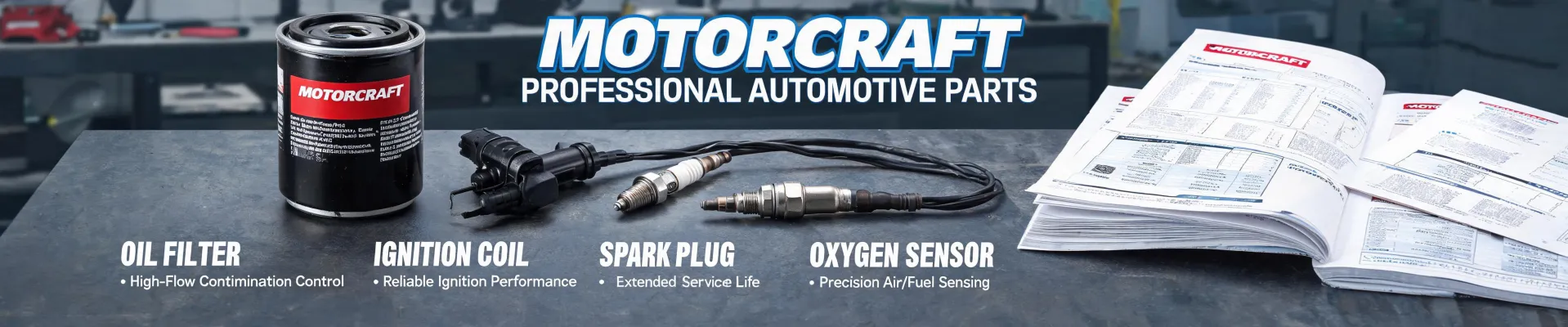
A practical guide to 2002 Ford F-150 5.4L Motorcraft parts—ignition coils, wheel hubs, alternator whine, muffler band clamps, and broken CV axles. Which repairs are worth the OEM price, which are urgent, and which can wait.
I handle purchasing for a 40-person logistics company. All parts and maintenance ordering—roughly $80,000 a year across six vendors—lands on my desk, and I report to both operations and finance. When I took over in 2020, I inherited a stack of invoices and no parts log. Five years in, I've made enough mistakes to know which parts justify the Motorcraft name and which ones don't.
Take this with a grain of salt: I'm a buyer, not a mechanic. But I've written the purchase orders, argued with the warranty line, and explained the delays to my VP more times than I care to count. So when someone asks me about the 2002 Ford F-150 5.4L, I don't give a stock answer. The right call depends on what's actually wrong with the truck, and there are four scenarios I see over and over in fleet life:
- Misfires — the 5.4L ignition coil problem
- Wheel noise — motorcraft wheel hub or CV axle?
- Alternator whine — and why it's not always the alternator
- Exhaust rattle — the muffler band clamp special
Each has a different answer. Let's go through them the way I wish someone had for me.
Scenario 1: The 5.4L Ignition Coil Misfire
The 2002 F-150 5.4L has a documented appetite for ignition coils. If you're getting a P0301 through P0308 code, rough idle, or a flashing check engine light, that's your world now. And this is the one place I stopped trying to save money early.
I assumed "same specifications" meant the same results when I ordered cheaper coils for one of our trucks. Didn't verify. Turned out the coil failed within six months, and the labor cost made the "savings" disappear. The Motorcraft DG-508 ignition coil is what this engine was designed with. In my opinion, that specificity matters. A generic coil can work. But you're not paying for the part—you're paying for the labor, the downtime, and the second invoice when it fails.
Why is the 5.4 worse than other engines about this? The coil-on-plug design means each cylinder relies on its own coil, and heat in the engine bay takes its toll over time. My shop foreman puts it bluntly: "You can replace one, or you can replace them all. Just don't expect the rest to wait politely while you fix one."
The all-at-once question comes up constantly. Here's my rule. Under 100,000 miles? Replace the failed coil and move on. Over 150,000? Bite the bullet and order the full set. The second time a coil dies on the highway, the "savings" of individual replacement feel pretty hollow.
Even after I ordered eight coils at once, I kept second-guessing. What if I was overspending and the cheap ones would've been fine? I didn't relax until that truck crossed 10,000 miles without a single misfire. Worth every penny.
Scenario 2: Wheel Noise — Hub or CV Axle?
Wheel noises get lumped together, but they're two different repairs with two different urgencies.
Motorcraft Wheel Hub Assembly
If you hear a droning or roaring that changes with speed—especially louder when you turn one direction—that's the wheel hub bearing. On these trucks, the hub assembly is one unit: bearing, hub, and ABS sensor. The Motorcraft wheel hub assembly is what I buy, every time.
Why? Because I've seen cheaper hubs fail around 20,000 miles. A lesson learned the hard way. The labor to install a hub is exactly the same whether the part costs $120 or $180, and the $60 you saved looks dumb when you're paying for the job twice.
You can confirm which hub it is by swerving slightly at highway speed: if the noise gets louder on a left swerve, it's the left hub, and vice versa. A trick my shop foreman taught me, and it saves diagnostic time.
And if It's the CV Axle?
Clicking when you turn, especially at full lock, points to a CV axle. And the question I hear from drivers: what happens if a CV axle breaks while driving?
Short version: you lose power to that wheel. The truck may still steer, but it won't pull itself anywhere. Long version: a snapped axle can flail around and damage the transmission seal or a brake line. What started as a $150 axle turns into a $1,200 repair. Not great.
Does the replacement need to be Motorcraft? Honestly, no. Quality aftermarket CV axles are decent, more or less, and this isn't the part where I insist on OEM. But the timing matters more than the brand. If it's clicking, plan the repair within a week or two. Don't let a $150 job become a tow truck bill.
Scenario 3: Alternator Whine
Alternator whine is the sneaky one. It sounds like a charging problem, follows engine RPM, and gets louder when you accelerate. But here's the thing: it's often a grounding issue, not the alternator at all.
I once ordered a Motorcraft alternator, paid for install, and the whine came right back. The ground strap was corroded. A $15 part. By the time I'd paid for the alternator and the extra labor, I was in deep. Now I check the easy stuff first: battery terminals, ground straps, belt condition.
Sometimes the whine only appears through the speakers. If that's your case, it's likely a radio ground loop, not the charging system. Test that before you buy anything.
Per FTC guidelines (ftc.gov), a claim like "OEM quality at a fraction of the cost" has to be substantiated with evidence. But marketing claims don't fix trucks. If the charging system checks out—engine running, battery reads roughly 14 volts—the alternator is probably not the problem. When the alternator does actually fail, the Motorcraft replacement is a solid pick. Consistently reliable. But verify first. Don't do what I did.
Scenario 4: The Muffler Band Clamp
The muffler band clamp is the cheapest repair on this list. The clamps that hold exhaust joints rust, loosen, and suddenly the truck rattles at idle or growls under acceleration. If the muffler and pipes are otherwise solid, a stainless steel band clamp in the correct diameter fixes it. Generic is fine. It's just a piece of metal holding two pipes together.
Before you order, inspect the pipe where the clamp seats. If it's rusted thin, the clamp won't hold. Worse than expected. I've ordered the clamp, opened the box, and realized we needed a muffler section too. The truck sat an extra day while I sourced the right parts. Not ideal, but workable.
How to Tell Which Scenario You're In
Write down the symptom. That's the first step, and honestly, most of the battle. Here's the urgency ranking I use:
- Flashing check engine light, rough idle → Scenario 1. Highest urgency. A misfire sends unburned fuel into the catalytic converter, and a clogged cat is a $1,500+ repair you don't want to explain.
- Clicking when turning → CV axle. Replace within a week or two. The noise won't heal, and the collateral damage gets expensive fast.
- Droning/roaring with speed → Wheel hub. You have some time, but a seized bearing can take out the rotor and spindle. Schedule within a month.
- Whine that follows RPM → Scenario 3. Check the grounds before you buy anything. Least urgent, unless the battery light flickers.
- Rattle under the truck → Scenario 4. Usually the cheapest fix here. Low urgency, but don't ignore a holed muffler—fumes inside the cab are no joke.
If you're not sure whether it's a hub bearing or a CV axle, pay a shop for an hour of diagnostic time. That's an invoice I'm always happy to approve. Guessing wrong on wheel noise means ordering the wrong part, wasting the labor, and explaining the extra expense to finance. No thank you.
An informed customer asks better questions and makes faster decisions. That's why I keep a parts log for the fleet—every part number, every failure, every invoice. It's how I know which Motorcraft repairs matter and which ones just look urgent. Exactly what we needed.
About the author

Elise Novak is an automotive braking systems analyst specializing in brake pads, discs, rotors, calipers, shoes, drums, hoses, and complete brake kits. She uses UN Regulation 90 requirements and ISO 26867 dynamometer methods to examine friction stability, fade and recovery, wear, disc thickness variation, runout, and hydraulic integrity. Her work helps distributors, quality teams, and fleet buyers compare replacement parts, verify application suitability, and define incoming-inspection criteria.