A parts specialist breaks down why the cheapest oil and cabin filter on the shelf ends up costing the most — and what CP4 fuel pump failures, alternator battery drains, and OEM-spec parts like the Motorcraft FL-2081 actually teach us about quality.
In March 2024, a fleet manager called our parts desk at 6:40 in the morning. One of his vans had died on the highway at 38,000 miles. The diagnosis came back as a failed CP4 fuel pump — a repair that starts around $8,000 before any injector or line work, and climbs from there. The component whose entire job was to catch the contamination before it ever reached that pump costs less than dinner.
That call is why I have strong opinions about filters.
I run emergency parts sourcing at an automotive supply company. I've handled 400+ rush orders in six years, including same-day turnarounds for fleet clients who can't afford a truck to sit. And based on our internal data from those jobs, the same pattern shows up over and over: the part that fails is expensive, and the part that could have prevented it was treated as a bargain.
You probably think of filters as the cheap part. The maintenance chore. The thing you swap out because the manual says so. And that's exactly why they end up costing the most — because the whole point of a filter is to protect something that costs ten to a hundred times more than the filter itself. The moment you cheap out, you've quietly moved that cost onto the expensive thing.
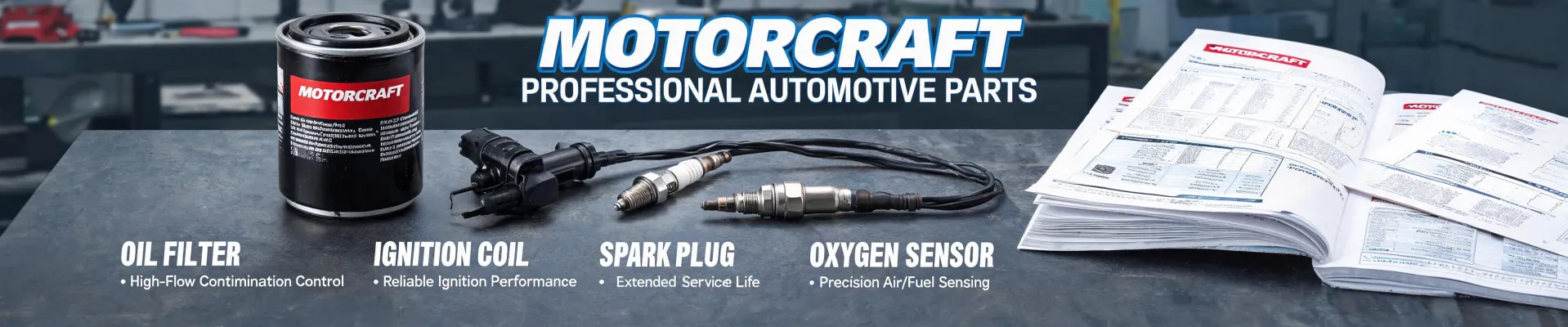
Two oil filters sit on the shelf in front of you. Both fit. Both feel solid in the hand. One is a Motorcraft FL-2081 engine oil filter, the other is a store-brand unit that looks close enough to fool a visual check. If you've ever stood there and thought, "It's the same part, I'll save a few dollars," you're not being cheap. You're being reasonable. And that's the problem.
The Surface Problem Nobody Questions
People treat maintenance parts as commodities. An oil filter is a can with a gasket. A cabin filter is a piece of folded paper. A fuel filter is a housing with a cartridge inside. From the outside, there's no visible difference worth paying extra for.
From the outside, an oil filter is an oil filter. The reality is that two filters with identical threads and identical gasket diameters can behave completely differently at 6,000 rpm and 200 degrees Fahrenheit — and the difference lives entirely in the parts you can't see.
Same story with the Ford Motorcraft FP-70 cabin air filter. Compare it to a generic like a Puro air filter and the outside looks fine on both: the pleats, the frame, the dimensions. Stand them side by side and you'd shrug. Put the wrong one in a car with a sensitive blower motor and a driver with allergies, and you'll find out where the money went. The shelf is designed to make this look like an easy decision. It isn't.
What's Actually Different Inside
When I'm triaging a parts order — which, in my role coordinating emergency replacements for fleet clients, happens constantly — I don't look at the filter. I look at what's inside it. That's where cheap filters save money, and every one of those savings shows up later in your engine.
Four things actually matter:
Filtration media. Premium filters use synthetic or synthetic-blend media with a controlled pore structure. Cheaper ones use a lower-grade cellulose that either lets contaminants through or clogs early and chokes flow. Neither failure mode is good for you.
Pleat count and density. More pleats mean more surface area and more contaminant capacity. Cheap filters run fewer pleats because folding media costs money. That's a filter that's already half-full the day you install it.
The bypass valve. This is the one nobody thinks about, and it's the one that quietly destroys engines. When oil is cold or the filter clogs, the bypass valve opens so the engine still gets oil pressure. If it's calibrated wrong — and the cheap filters I've torn down routinely under-engineer this spring — it opens too early and lets unfiltered oil circulate indefinitely. You'll never see a warning light. You'll just see the wear on your next oil analysis.
The anti-drainback valve. It keeps oil in the filter between starts. Cheap ones let it leak back, so every cold start runs dry for a second or two. Multiply that by a thousand starts a year and do the math.
Here's the part that bothers me most: the cheap filters I've inspected aren't reverse-engineered from the original. They're copied dimensionally and then engineered down. Same threads, same gasket — different truth. Plus, because the outside is identical, you have no way of knowing which one you're holding without cutting it open.
What It Actually Costs When You Cut Corners
The trap with cheap parts is the feedback delay. The day you install the cheaper filter, nothing happens. The car starts, the oil pressure light goes out, the engine sounds fine. So you conclude the expensive filter was overpriced.
You don't see the wear for 5,000 miles. Or 50,000.
And with fuel systems, you might never see it coming at all.
The CP4 Wake-Up Call
CP4 fuel pump failure is the clearest example I can give you of a cheap-part decision turning into a four-figure repair. The CP4 is a high-pressure pump that runs on a film of fuel for lubrication. It expects clean fuel with proper lubricity. Water, fine debris, or degraded fuel scores the internal surfaces, and the pump starts shedding metal.
Once it does, that metal doesn't stay put. It travels downstream into the injectors, the lines, the rail, the tank. A pump failure becomes a full fuel-system replacement. Owners I've talked to have been quoted repair bills between $8,000 and $12,000 depending on how far the contamination traveled before anyone caught it.
And the component whose entire job is to catch that contamination before it reaches the pump? A fuel filter. Usually the one people replace last.
I still kick myself about a customer from 2022. He asked for the cheapest fuel filter we stocked to save maybe twenty dollars. Eight months later he was in for the pump. If I'd pushed back harder — if I'd taken five minutes to explain what that filter was protecting — he'd have spent twenty dollars and avoided a repair that nearly totaled the truck.
The Slow Drain You Don't Notice
Not every cheap part fails catastrophically. Some just quietly degrade the system around them, and the electrical side is where that shows up most.
A marginal alternator or a sloppy connection doesn't usually announce itself. It just works a little less well than it should, and the symptom — a battery that keeps going flat — gets blamed on the battery. So you replace the battery. Then you replace it again. And the problem keeps coming back.
If you want to know how to check if the alternator is draining the battery, the short version is this: with the engine off, put a multimeter in series on the negative terminal and measure parasitic draw (10–50 milliamps is normal on most modern cars; anything over 50 mA means something is staying awake). Then, with the engine running at idle, check voltage at the battery — you want to see 13.5 to 14.5 volts. If it's low, the alternator isn't charging. If the draw is high, something is draining it. The battery is the victim far more often than it's the cause.
We didn't have a formal electrical diagnostic checklist until 2023. Cost us when a client came back three times with the same flat-battery complaint, and we replaced two perfectly good batteries before we finally tested the drain. That mistake is what created the checklist.
The Fix Is Boring, and That's the Point
The answer isn't complicated: match the part to the spec, then don't deviate.
For oil, that means the Motorcraft FL-2081 when that's the factory fit. Not because of the logo — because the bypass valve calibration, media, and anti-drainback behavior were designed against that specific engine, not against a shelf. For cabin air, the Ford Motorcraft FP-70 gets you the filtration efficiency the system was built around. A Puro air filter might drop into the housing perfectly and still miss the airflow or particulate spec the blower and the driver were counting on.
For the fuel system, buy the OEM-spec filter and change it on schedule. That's the whole trick. The pump that costs four figures is protected by the filter that costs two.
And if your electrical system is acting up, test before you replace. Parasitic draw and charging voltage take ten minutes to measure and will save you a rotating cast of replacement batteries.
One nuance worth knowing: the Magnuson-Moss Warranty Act (enforced by the FTC) protects your right to use aftermarket parts without automatically voiding your warranty. But it protects your legal right — it doesn't protect you from the engineering consequences of a badly made one. The law is on your side. Physics isn't.
Bottom Line
The part you can see is almost always cheaper than the system it protects. That's why the cheap filter is never actually cheap — it just moves the cost somewhere you won't notice until it's too late to argue about.
Buy the part that matches the spec. Change it when the book says to. And the next time you're standing in front of two filters that look identical, remember that the difference was never on the outside.
About the author

Elise Novak is an automotive braking systems analyst specializing in brake pads, discs, rotors, calipers, shoes, drums, hoses, and complete brake kits. She uses UN Regulation 90 requirements and ISO 26867 dynamometer methods to examine friction stability, fade and recovery, wear, disc thickness variation, runout, and hydraulic integrity. Her work helps distributors, quality teams, and fleet buyers compare replacement parts, verify application suitability, and define incoming-inspection criteria.