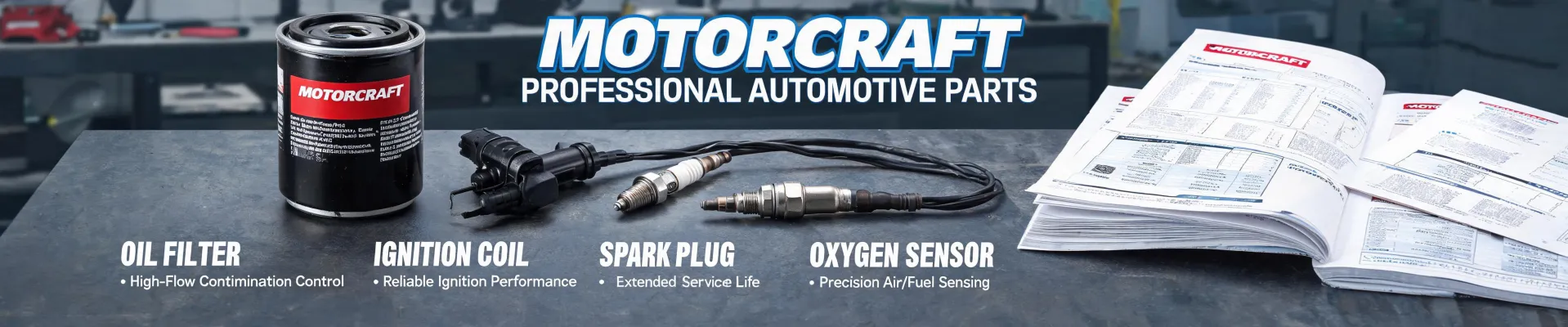
A ten-year automotive parts sourcing veteran breaks down the real OEM vs aftermarket comparison—covering fit tolerances, total cost of failure, and supply chain lead times, with hard lessons from actual ordering mistakes.
I've been sourcing automotive parts for ten years. In that time I've personally made 14 significant ordering mistakes totaling roughly $14,000 in wasted budget. I document every one of them now, and since Q1 2024 I've maintained our team's pre-order verification checklist so the junior buyers don't repeat my errors.
The question I get asked most—by our own staff and by the shops we supply—is the same one: OEM or aftermarket? Motorcraft or the budget option?
I'll give you a straight answer upfront, then show you the reasoning, because it's not as simple as picking a side. I compare parts on three dimensions: fit and tolerance, total cost of failure, and supply chain lead time. Each one has cost me money to learn, and I'll give you the stories.
Fit & Tolerance: The Difference You Can't See on a Screen
The hardest lesson I've learned is that "cross-reference matches" does not mean "spec matches."
In March 2022, I ordered 150 rear control arm bushings from an aftermarket supplier for a fleet client. The catalog said the part number crossed to the OEM reference, and the price was about 40% less than the Motorcraft equivalent. I approved it without verifying the actual drawings. They fit on the bench. No issues.
Six months later, we'd replaced 12 of them.
What happened: the aftermarket bushing's inner sleeve was manufactured right at the minimum end of the tolerance range. After heat cycling, it loosened inside the arm. The OEM spec is tighter, and you can't catch that by looking at a photo or a catalog page. We didn't have a formal verification process for checking part dimensions against the original drawings. That gap cost us about $2,800 in rework and a very unhappy fleet manager.
I only believed in tolerance verification after ignoring it once and eating that cost. Our senior engineer had warned me about this exact issue on suspension components. I didn't listen. It's still the most expensive lesson on this list.
To be clear: I'm not claiming every aftermarket bushing is junk. Some aftermarket companies have invested heavily in CNC machining and quality inspection, and it shows. But "fits in the control arm" is not the same as "meets the engineer's spec." On safety-critical parts, that gap matters.
Total Cost of Failure: The Price Tag Isn't the Price
This is the dimension where I see most buyers go wrong. They compare unit prices and stop there.
Example: at my wholesale distributor, the Motorcraft FL-2016 oil filter runs about $10. Aftermarket equivalents go for $4–6. On paper, buying aftermarket looks obvious.
Now factor in what happens when a filter isn't up to spec. On a properly maintained fleet, a filter that lets debris through can take out an engine. That's a $4,500 repair, plus downtime. A $5 per-unit savings starts looking kinda stupid when you're writing that check.
Same logic applies to ignition parts. I've seen a shop install aftermarket coil packs on a 2008 F150 4.6L because they saved $12 per unit versus the OEM Motorcraft coil pack. The customer was back within four months with a misfire. The factory unit had run 90,000 miles without a problem. The replacement failed at about 12,000. The labor to redo it wiped out any savings from the initial price difference.
My rule now is to compare cost per 10,000 miles, not cost per unit. The Motorcraft coil pack can be two and a half times the price and still be cheaper if it lasts four or five times longer. That math isn't hard once you run it, but most buyers don't.
I use the same approach when customers ask me "how much for a catalytic converter?" OEM converters run $800–2,500 for most vehicles based on quotes I've pulled over the past 12 months. Aftermarket units are usually $400–1,200. But the labor is the same either way, and the warranty risk is not. I quote both sets of numbers and let the customer decide with all the information.
Supply Chain & Lead Time: The Surprise
Here's the dimension that flipped my assumption completely. I used to believe aftermarket always had better availability. Turns out, not even close.
Aftermarket suppliers hold thinner inventory because demand forecasting is harder for them. I once ordered CV axle bushings from a well-regarded aftermarket brand that showed "in stock" on their portal. They had the catalog listing, but when the warehouse went to pick it, the shelf was empty. Three-week backorder for a $30 bushing that takes 20 minutes to install. We told the customer we'd have it "in a few days." That was a fun phone call.
OEM distribution is built differently. Motorcraft's supply chain is designed around committed delivery schedules and inventory targets, because automaker production lines depend on it. With a wholesale account, I get a firm ship date instead of a guess. That's what IATF 16949 audits are partly about—supply chain reliability is baked into the certification.
But I'll be fair: OEM can be slow for older or low-volume applications. Just because a part is genuine doesn't mean it's in a regional warehouse. If you have a 2008 F150 4.6L with a coil pack, you're fine—those trucks are everywhere and the Motorcraft parts are well-stocked. For a discontinued platform, you might wait a week for OEM when an aftermarket option is on your local counter.
My SOP now: check lead time before price. If a vehicle is down and waiting, an aftermarket part arriving today beats an OEM part arriving in ten days—for non-safety-critical components. For suspension or ignition, I'll put the customer in a loaner and wait for the right part. That's the call I make every time now.
The Decision Framework
After a decade and $14,000 in mistakes, here's the framework I actually order by:
- Safety-critical or hard-to-replace components (bushings, coil packs, engine internals): OEM/Motorcraft, unless the aftermarket part has verifiable OE-grade certification. The verification is non-negotiable.
- Wear items with predictable replacement intervals (oil filters, belts): either works. But if the vehicle is under factory warranty, use Motorcraft so there's no argument at the claims desk.
- Legacy or low-volume applications: whichever ships first. But measure the part against OEM drawings before installation, no exceptions.
- Price-sensitive fleet decisions: run the cost-per-10,000-miles calculation before you commit. If the numbers are close, go OEM.
The industry has changed a lot since I started. Aftermarket manufacturing quality is seriously better than it was ten years ago. I've tested budget components that exceeded expectations, and I've seen OEM parts that were hard to source. Anyone who tells you "aftermarket is always worse" or "OEM is always better" hasn't been paying attention.
But some fundamentals haven't moved. Unverified parts are a gamble, and the house always wins eventually.
Our checklist now includes part number verification, physical dimension checks on bushings and mounts, and OE spec review on anything safety-related. Since we put it in place in Q1 2024, we've caught 47 potential order errors—that's roughly $47,000 in avoided waste. Give or take a few thousand; I'd have to check the latest report.
That is the real answer to the OEM vs aftermarket question. Neither one is universally right. Verified parts, matched to the application, with the true cost calculated over the life of the part—that's the only answer that's held up over ten years of making and correcting mistakes.
Pricing references are based on U.S. distribution pricing as of early 2025; actual prices vary by region, volume, and time of order. Verify current pricing with your distributor.
About the author

Elise Novak is an automotive braking systems analyst specializing in brake pads, discs, rotors, calipers, shoes, drums, hoses, and complete brake kits. She uses UN Regulation 90 requirements and ISO 26867 dynamometer methods to examine friction stability, fade and recovery, wear, disc thickness variation, runout, and hydraulic integrity. Her work helps distributors, quality teams, and fleet buyers compare replacement parts, verify application suitability, and define incoming-inspection criteria.