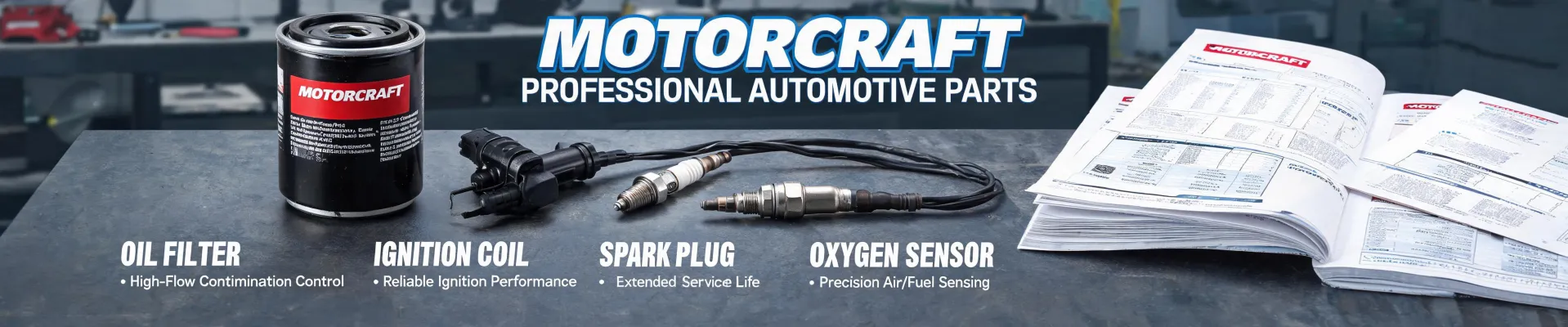
A fleet parts buyer compares genuine Motorcraft SP-542 plugs and voltage regulators to aftermarket alternatives for the 2019 F-150 5.0. Covers fitment, lifespan, total cost, and when aftermarket parts make sense.
I manage parts purchasing for a company that runs about 60 Ford F-150s across three states. When a truck needs plugs, an alternator, or a voltage regulator, I'm the one who has to decide where that part comes from. I'm not a mechanic. I'm the person who makes the money work and keeps the shop from getting blamed for something that wasn't their fault.
Almost every new service manager asks me the same thing: Why do we keep ordering Motorcraft when there are cheaper options right there on the screen?
That's a fair question. It deserves a real answer. Here's mine based on five years of buying replacement parts for a working fleet.
What I'm Actually Comparing
This is a comparison between genuine Motorcraft parts and aftermarket "direct replacement" parts. The main example I use is the 2019 F-150 5.0 spark plug, because it's the most common job we do. I'll also talk about voltage regulators and alternators, because that's where I got burned once and learned the lesson the hard way.
I evaluate any part on four things:
- Fitment — will it seat and seal correctly the first time?
- Lifespan — will it make it to the expected service interval?
- All-in cost — not just unit price, but labor, downtime, and repeat repairs.
- Warranty support — if it fails, how painful is the fix?
If you search for 2019 F150 5.0 spark plugs motorcraft, you'll see that the Motorcraft SP-542 is the original plug for this engine. And you'll also see comparable plugs for less money. What's the difference, really?
Fitment: "Same Specs" Didn't Mean the Same Results
Back in 2021, I assumed that identical specifications meant identical results across vendors. That was a mistake.
We ordered a batch of aftermarket iridium plugs listed as exact equivalents for the 5.0L. Threads looked right. They went into the cylinder heads easily. Three trucks left the shop that week.
Six weeks later, one of those trucks came back with a misfire code on cylinder 7. When the tech pulled the plug, the ground electrode had a hairline crack and the gap had opened up. Another truck had a coil boot that didn't seat as cleanly as it did on the Motorcraft plug, and it had an intermittent rough idle that took two visits to properly diagnose.
Compare that with the Motorcraft SP-542 units we've installed: in roughly 60 complete plug jobs over the last few years, I can't remember a single plug-related misfire before 80,000 miles.
Here's the part that surprised me when I looked into it: Motorcraft doesn't manufacture raw spark plugs from scratch. It sources them from established ignition manufacturers. But Motorcraft controls the specification, the tolerances, and the validation testing for Ford engines. The same factory can produce an aftermarket plug and a Motorcraft plug with different quality requirements and heat ranges.
Look, I'm not saying aftermarket plugs are always garbage. I've seen them run perfectly fine in personal vehicles. But in our line of work, an unplanned repair costs more than the part itself. A truck that goes down in the middle of a job doesn't just cost us a spark plug — it costs us the day.
Lifespan: What "100,000-Mile Plug" Actually Means
The factory maintenance schedule for the 2019 F-150 5.0 says to replace spark plugs at 100,000 miles. The genuine Motorcraft plug is iridium-enhanced, which matters because the Coyote engine's coil-on-plug design puts a lot of demand on the electrode.
I can only speak to what I've seen in our own fleet. And "fleet" is not a controlled laboratory. Our F-150s are street-driven, carry tools and parts, and sit in city traffic more than they hit the highway. It's not a scientific sample. But it's the sample I have.
Between 2020 and now, we've installed roughly 200 Motorcraft plugs across these trucks. We had one early failure. During a test period back in 2022, we tried aftermarket iridium plugs in a handful of vehicles — about 48 plugs total. Four of them failed before 30,000 miles. One left a driver stranded at a client's site.
Four out of forty-eight isn't a catastrophic failure rate. But when one failure requires a tow, a missed appointment, and a second labor charge, you don't need a 50% failure rate to make the math hurt.
Sticker Price vs Total Cost
Let's talk money, because that's the part that actually makes people hesitate.
As of March 2025, the Motorcraft SP-542 typically runs somewhere in the $8 to $13 range if you buy from a dealer or a reputable online parts seller. Aftermarket iridium equivalents often list for $5 to $9. Prices vary by vendor and time of order, so verify current rates before making a decision.
Per plug, the difference is around three to five dollars. For eight plugs, that's $24 to $40 per truck. I understand why a maintenance manager would look at that number and think we're wasting money.
But here's the thing: the labor to replace spark plugs on a 5.0 F-150 is more than the parts. Shop rates in our area run about $85 to $110 per hour, and a plug job is generally an hour to an hour and a half including test drive time. That comes out to $85 to $165 in labor alone. Whether the plugs cost $50 or $90, labor dominates.
So what happens when an aftermarket plug fails at 20,000 miles? You pay for a new part, sure. But you also pay for the labor to install it. And you pay for the diagnostic time to find the misfire. And you might pay for a missed customer appointment that you can't bill to anyone.
The cheapest part is rarely the cheapest part once you include all the ways it can go wrong.
A Caution About the Motorcraft Voltage Regulator Search
One more thing I want to flag: if you type motorcraft voltage regulator into a search engine, you'll see parts for older Fords and other vehicles. That part exists and it's fine. But on a 2019 F-150 5.0, the voltage regulator is built into the alternator. It's not a separate component you can replace by itself.
I learned this during a 2023 repair when a driver reported flickering lights and an intermittent charging warning. Our usual supplier suggested replacing the alternator. The quote for a rebuilt aftermarket unit was about 40% less than a genuine Motorcraft remanufactured alternator. And I'll be honest — I almost went with the cheaper option because the numbers looked good.
Every spreadsheet analysis pointed to the budget choice. Something felt off. I had a bad feeling about how quickly the salesperson moved on from warranty questions. Turned out my gut was right.
The aftermarket alternator's internal voltage regulator failed nine months later. The replacement cost us labor. Then the replacement for that replacement was a Motorcraft remanufactured unit. In total, we spent more than if we'd bought the Motorcraft part first. The manufacturer of the aftermarket unit did offer a warranty, but getting anything done meant finding a receipt, calling a support line, and explaining the situation to someone who clearly didn't care about a commercial account.
When the Motorcraft unit had an issue once, I called a Ford dealer, gave them the part number and serial, and they handled the exchange without a fight. That kind of support has real value, even if it doesn't show up on a purchase order.
So When Would I Actually Buy Aftermarket?
I'm not going to tell you that Motorcraft is the only brand worth buying. That would be a convenient sales pitch, but it wouldn't be completely honest.
There are situations where aftermarket parts make sense:
- When the vehicle is close to being sold or auctioned. If a truck has 180,000 miles and is leaving the fleet in two months, the economics change. You just need it to run until it's gone.
- For non-critical parts. Wiper blades, certain sensors, trim pieces — parts that won't strand a driver on the side of the road.
- When you have specific knowledge. If you've used a particular aftermarket brand in a particular engine and you know it works, that's your call to make.
But for the 2019 F-150 5.0 spark plug replacement, the Motorcraft plug isn't a luxury upgrade. It's the part the engine was designed around. The price difference is something like $3 to $5 per plug. That's $24 to $40 for the whole truck. You're paying that for fewer surprises.
In my world, no surprises is the entire job.
Bottom Line
The same logic applies beyond spark plugs and alternators. Whether I'm buying exhaust parts for a diesel truck, looking into an HJS catalytic converter for one of our work vans, or sourcing a replacement muffler for a Kohler 7000 series engine on the yard equipment, I ask the same questions: Who actually made this part? Who stands behind it if it fails? And what does a failure cost us in labor and downtime?
Take this with the context it deserves. Our fleet runs in moderate climates and mostly on paved roads. If you're working trucks in extreme cold, heavy dust, or with aftermarket tuning, your experience might be different. My sample size is real but small — I'm a purchaser, not an engineer.
If you're making this decision for your own truck or your own fleet, don't just compare the per-unit price. Compare the total cost of a part that fails early against the cost of a part that doesn't. That comparison is the one that actually matters.
About the author

Elise Novak is an automotive braking systems analyst specializing in brake pads, discs, rotors, calipers, shoes, drums, hoses, and complete brake kits. She uses UN Regulation 90 requirements and ISO 26867 dynamometer methods to examine friction stability, fade and recovery, wear, disc thickness variation, runout, and hydraulic integrity. Her work helps distributors, quality teams, and fleet buyers compare replacement parts, verify application suitability, and define incoming-inspection criteria.