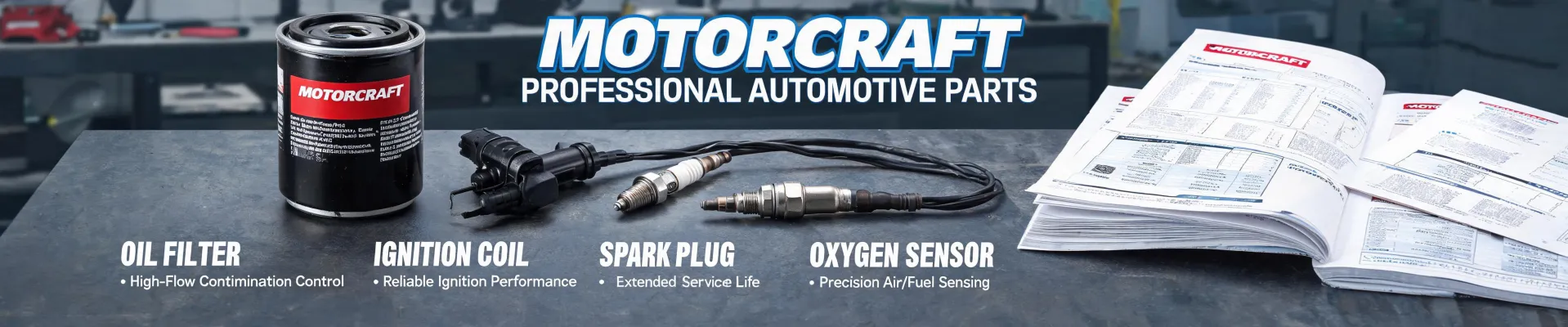
A quality compliance manager explains when Motorcraft coil packs, oil filters, and exact specs are worth the premium—and when aftermarket parts like Power Stop and Auxito can make sense.
I'm a quality compliance manager at an automotive component supplier. I review a couple hundred part numbers a year—maybe 200, give or take—and in 2024 I rejected about 6% of first-article deliveries. 5.8%, if I'm being precise. Most rejections were for dimensional or documentation issues, not because the parts were unbuildable. So when I talk about Motorcraft parts, it's not brand loyalty. It's probability. The real price of a part is the cost of touching the vehicle twice.
Honestly, that's the whole thesis: the cheapest part is only cheap if it works the first time. In a deadline repair, the risk of “probably fits” gets expensive fast.
Why I evaluate parts from the print, not the label
I didn't always think this way. Early on, I approved a batch of formed brackets because the easy measurements looked fine. The assembly line rejected them anyway because the hole pattern was rotated almost a degree. That redo cost us around $22,000—or rather, $22,400 once we counted the overtime. We didn't have a formal verification checklist for substitute parts at the time. Now we do.
What does that have to do with Motorcraft? An OEM spec is just a set of tolerances on paper. In practice, it's documented consistency. Motorcraft parts are tied to Ford and Motorcraft engineering requirements, which means the supplier had to prove the part works in the real application. An aftermarket part might work too—I'm not going to say it won't. But unless you have a dimensional report or test data, you're guessing. And in a service environment, guessing has a measurable cost.
This was accurate as of early 2025, by the way. Supply chains shift, so verify current part numbers before you order anything.
Where I'm least flexible in my review queue
Motorcraft coil pack 3.5 EcoBoost: where I hold the line
The Motorcraft coil pack 3.5 EcoBoost replacement is one of the places I don't substitute. Coil packs don't always fail in a way that's obvious on a bench test. They can pass at idle and misfire under load. A cheaper coil may look identical and even throw the same code, but the internal driver and dwell characteristics aren't always equal. For a truck that tows or a fleet vehicle that runs all day, this is not the place to save $30.
In March 2024, we had a fleet truck down with a misfire. The cheapest coil we found was $22 and would take four days to arrive. The Motorcraft version was $68 and available next morning. We paid the extra $46. That wasn't for the logo—it was for getting the truck back to work a day sooner and not risking a second visit.
Motorcraft oil filter FL-820S
The Motorcraft oil filter FL-820S gets recommended a lot, and for good reason. It's a simple spin-on filter, but the bypass valve calibration and thread spec are known quantities. A generic filter that threads on may work fine, but if the bypass opens at a different pressure, it can lead to a confusing oil-pressure code or, worse, a scored bearing in extreme cases. I remember chasing a low oil-pressure complaint on a 5.0 after an oil change with a budget filter. The oil level was correct, the pump was fine, and the sender was fine. We swapped the filter back to an FL-820S and the code cleared. Was the filter definitively the problem? I can't prove it. That's exactly the point—why introduce a variable I can't verify on a warranty-adjacent engine?
Power Stop Z23 Evolution Sport brake kit reviews
This one is tricky because there's a lot of internet noise. Power Stop Z23 Evolution Sport brake kit reviews are easy to find, and the kit gets credit for low dust and decent pedal feel. I haven't dyno-tested that brake kit, so I'm not going to give it a rating. What I do in my role is check friction material certification and rotor runout before any brake kit goes into a customer's fleet. A good review tells you how it felt to one person; it doesn't tell you if the rotor thickness variation will stay within the OE limit over 20,000 miles.
Auxito LED headlight bulbs: not my rating to give
Same thing with lighting. I can't verify Auxito LED headlight bulbs from my job—I don't do photometric testing. But I can tell you that swapping a halogen bulb for an LED in a reflector housing changes the beam shape, no matter how well the bulb is made. If the cutoff isn't built into the housing, you're going to glare at oncoming traffic. That's not an Auxito-specific flaw; it's a physics issue.
A picture of a flywheel isn't enough
One more example from my workflow: people send a picture of a flywheel and ask, “Is this the right one?” A picture of a flywheel helps, but it can't confirm tooth count, crank pilot diameter, or the clutch surface step height. Last month a photo looked perfect; the actual part had the wrong pilot bore by 0.018 inch. A caliper would have caught it in 30 seconds. A photo won't. I still kick myself for trusting the photo before measuring it.
What you're actually buying in a rush
In an urgent repair, you're not buying a part. You're buying the probability that the job is done once.
The time-certainty idea is simple: when a deadline matters, the cost of a wrong guess goes up fast. Let me put it in numbers. Say a work truck makes $900 a day for you. A $22 coil that arrives in four days means 3.5 days of downtime if it fails—or even if it doesn't fail but you want a known-good part. The $68 Motorcraft coil gets you back on the road tomorrow. The difference isn't $46. The difference is $3,150 in avoided downtime plus the peace of mind. In that situation, paying for certainty is the cheaper option.
Obviously, that math only works when time is actually money. If your car is a weekend project and can sit in the driveway, the risk profile changes completely.
When I'd go aftermarket
I don't want this to sound like “OEM or nothing.” That's not true, and it's not honest. I'd go aftermarket when:
- It's an appearance part like trim or a badge, and the fitment is verified.
- It's a flywheel or flexplate, and the supplier includes a dimensional report and balance spec—not just a photo.
- It's a brake pad from a known friction supplier, and the rotor runout is measured before installation.
I'd also go aftermarket on anything where you have time to return a wrong part. The uncertainty cost is lower when you can wait, test, and swap.
Your mileage may differ
My experience is based on fleet and service repair conditions, mostly between 2020 and 2024. I haven't worked in high-end performance tuning or full aftermarket validation labs, so if that's your world, take this accordingly.
So here's the practical version: use the OEM part when downtime is expensive, when the spec is safety-related, or when you can't verify the substitute. Use aftermarket when you have the time and information to make a good decision. And never trust a part number based on how it looks in a picture—measure it, confirm it, then install it. If you do it right the first time, that's the cheapest part you'll ever buy.
About the author

Elise Novak is an automotive braking systems analyst specializing in brake pads, discs, rotors, calipers, shoes, drums, hoses, and complete brake kits. She uses UN Regulation 90 requirements and ISO 26867 dynamometer methods to examine friction stability, fade and recovery, wear, disc thickness variation, runout, and hydraulic integrity. Her work helps distributors, quality teams, and fleet buyers compare replacement parts, verify application suitability, and define incoming-inspection criteria.