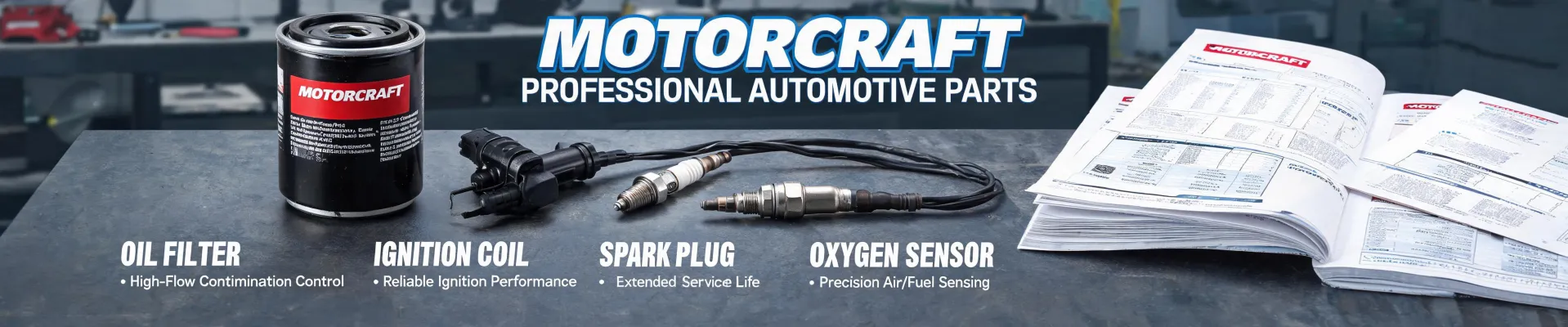
From a Motorcraft spark plug to a Toyota head gasket, an auto parts manufacturer explains why correct part numbers still produce wrong parts—and how to verify before it costs you.
When the Part Number Is Right but the Part Isn’t
Since 2016 I’ve worked on the supply side of automotive parts. The plant I work for builds metal components for automotive manufacturers: stampings, stamping dies, forging parts, aluminum extrusions, and CNC-machined parts. Most of that work is about following specs. But the mistakes I’ve seen—and the ones I’ve personally made—aren’t usually about the parts on the floor. They’re about how we interpret part numbers at the desk.
Over the last nine years, I recorded 14 significant errors in our procurement and receiving process. Together, those errors burned roughly $11,000 in wasted budget. I kept the list mostly so I would stop repeating them. Today I maintain our team’s pre-order checklist. This article is about the pattern that caused most of that damage.
It wasn’t a typo in a part number. The part number was correct. The label said the right thing. But the part still didn’t work.
The Surface Problem: Parts That Look Right
My most expensive example started with a simple request: Motorcraft spark plug SP-493-X. We needed it for comparison testing on a customer’s engine. The customer asked for that exact number.
The order went through our system. The supplier box was marked SP-493-X. The packing slip matched. The visual check passed. Everything pointed to the same conclusion: correct part.
But it wasn’t. SP-493-X is a variant with a specific heat range and electrode gap. The base number in the same family looks similar, but it runs differently. Two hundred spark plugs went into that test before the test stand noticed the difference—misfire, invalid results, and a stop to the whole schedule.
I’ll be honest: we could have compared specs before installation. We didn’t. We validated the label and skipped straight to “it’s correct.” Oh, and the parts looked identical on the outside. That’s what made the mistake so easy to miss.
The same logic hit us on a clearance buy. Our purchasing office found a Motorcraft FP-70 cabin air filter (clearance) at a good price. But clearance doesn’t just mean “discount.” It often means discontinued, old version, or replaced by another part. FP-70 no longer matched the current mounting interface on our test vehicles. We bought 30 units, tried to install them, and threw them away. We saved maybe $4 on each filter and spent over $600 in rejected installation labor.
Other brands had the same issue. A customer requested a Toyota head gasket. We checked the catalog for a Toyota 2.5L engine gasket. But “2.5L” wasn’t enough: the engine had been redesigned mid-cycle, which changed the coolant port layout. We shipped 40 gaskets. They came back. Nobody asked the engine generation. Nobody volunteered it.
Even the smallest parts have this trap. When we needed a CV joint retaining ring, we checked the axle groove diameter and assumed the rest was standard. The diameter was correct. The material didn’t have enough holding strength. Two rings failed during testing.
The Real Problem: Why We Kept Getting It Wrong
Looking through my notes, these looked like random mistakes. But a pattern emerged. Let me walk through it layer by layer.
I don’t have hard data on how often this happens across the industry. I can only give you the view from one manufacturing team. But the pattern was consistent enough that I built a system to stop it.
We Confused “Correct Part Number” with “Correct Part”
A part number is an identifier, not a specification. When the label says SP-493-X, it tells you the part is linked to that ID. It doesn’t tell you whether that part matches your application. To make that connection, you have to read the spec sheet. Heat range. Gap. Dimensions. Material. Hardness.
Skipping that step is easy, especially when the brand is a trusted name like Motorcraft and the box looks right. But the right ID and the right application are not the same thing.
We Let Brand Names and Bargain Prices Replace Verification
The Motorcraft name adds confidence. A clearance price adds urgency. When both show up together, it’s very easy to ignore risk. But brand and clearance are context clues, not proof of compatibility. If an item is on clearance, there is usually a reason. The best reaction isn’t “good deal.” It’s “what replaced it?”
We Allowed Vague Requests to Stay Vague
Toyota head gasket is a request that should trigger questions: exact engine code, generation, revision, casting marks. Instead, we accepted an order that ended at a simple description. That wasn’t a failure by the customer alone. It was a shared ambiguity. Both sides assumed the other had the missing details.
We Trusted the Size Number and Ignored Physical Properties
For the CV joint retaining ring, the number matched: the diameter was the same. But the physical part also has a material grade, hardness, surface finish, and edge profile. None of those can be read from a diameter measurement. When a part is small and looks simple, we tend to reduce the check to one or two dimensions. That’s exactly where failure slips in.
The Cost: More Than the $3,200 Spark Plug Order
The spark plug order itself was 200 Motorcraft units at about $16 each–$3,200 in parts. That was the visible cost. But each mistake also had hidden costs: retest time, overtime, expedited shipping, and lost customer confidence.
In total, our 14 errors came to about $11,000. On some budgets, that’s not a major number. In a parts procurement process, it’s a pile of waste, and all of it came from preventable checks.
Around 2019, I realized the biggest cost wasn’t money. It was internal confidence. When people started questioning every incoming part, everything slowed down. Trust started leaking from the inside.
The Simple Fix: How We Stopped Repeating It
I now use a four-point checklist. It’s short, but it forces me to do the things that would have prevented every mistake I listed:
- Check the label against the spec sheet. If the tag says SP-493-X, open the catalog and confirm the heat range, gap, and other critical specs. Every time.
- Question special pricing. When something is sold as clearance, ask why. Is the version discontinued? Is this old stock? What replaced it?
- Turn short descriptions into full specifications. “Toyota head gasket” is not a full spec until you know the generation and revision. Keep asking until there is no ambiguity.
- Compare the physical part, not just the numbers. For a CV joint retaining ring, look at cross-section, finish, and hardness. For a gasket, match the coolant holes. For an air filter, follow the airflow arrow printed on the frame.
That last point sounds basic, but it applies everywhere. People search for “how to put air filter in furnace” and get the same answer: check the size, check the direction. Even the simplest installation requires a verification step. Car parts are no different. In fact, it matters more when the part number is right, because that’s when the mistake is easiest to miss.
The right part number is the starting line. The right part is the finish line. The distance between them is verification.
About the author

Elise Novak is an automotive braking systems analyst specializing in brake pads, discs, rotors, calipers, shoes, drums, hoses, and complete brake kits. She uses UN Regulation 90 requirements and ISO 26867 dynamometer methods to examine friction stability, fade and recovery, wear, disc thickness variation, runout, and hydraulic integrity. Her work helps distributors, quality teams, and fleet buyers compare replacement parts, verify application suitability, and define incoming-inspection criteria.