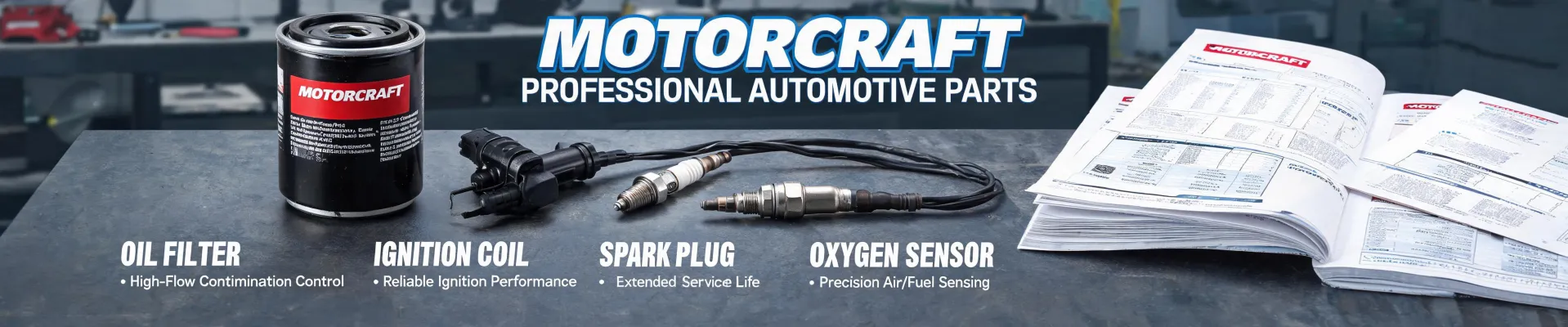
A parts coordinator with 400+ rush orders of experience explains why the cheapest oil filter (including the 2021 F-150 5.0's Motorcraft spec), oxygen sensor, and alternator rebuild often become the most expensive choice. Includes the real answer to how often to change a car's air filter.
The most expensive part I've watched someone install cost $12. It wasn't a sensor or an alternator—it was an aftermarket oil filter chosen over the Motorcraft FL-500S during a rush oil change on a 2021 F-150 5.0. The filter looked right, threaded on fine, and passed the leak check. But its bypass valve didn't match the specification the engine was designed around. At 4,000 miles, the truck came back with a low-oil-pressure code. The filter was partially collapsed.
That's the pattern I've seen repeated in eight years of handling rush parts orders: the cheapest part only looks cheap until it causes a second diagnostic, a second install, and a conversation with a customer who's lost trust. When you're buying a part under time pressure, you're not buying the part—you're buying the outcome. And the outcome includes what happens if that part fails.
I'll share what 400+ rush orders taught me about oil filters (including the 2021 F-150 5.0's Motorcraft spec), oxygen sensors, alternator rebuilds, and how often to change your car's air filter—along with the times when buying cheap is genuinely fine.
Because when a vehicle is down and the clock is running, I think about three things: how many hours are left, whether the part can physically get here in time, and what the worst case looks like if it fails. The worst case with a cheap part isn't the part. It's the second visit. The first visit was booked at normal shop rate. The second visit is where you make no money, burn goodwill, and explain to a customer why the 'cheap' repair didn't hold.
Who's writing this and why you should listen
I'm the parts coordinator at an independent components supplier that serves repair shops and small fleets on tight deadlines. In the past eight years, I've handled 400+ rush orders—or rather, 380-something; I'd have to check the log to give you an exact count. Same-day turnarounds for fleet operators, emergency deliveries for shops with a customer's vehicle already on the lift, and more than a few weekend calls I didn't want to take.
The most expensive mistakes I've seen weren't caused by lack of speed. They were caused by decision quality dropping under time pressure. Something breaks, the clock starts, and suddenly the '$12 filter that's in stock' beats the '$17 filter that's 30 minutes away.'
In March 2024, 36 hours before a fleet customer's DOT inspection deadline, the alternator in one of their delivery vans died. The shop manager chose a discounted 'rebuilt' alternator at $90 below the new OEM-spec price. Six weeks later, the regulator failed mid-route. The total cost of that $90 savings: another tow, another alternator, a second labor charge, and a client conversation that no invoice line item covers.
Where 'good enough' fails (and why)
Oil filters: the 2021 F-150 5.0 Motorcraft spec matters
It's tempting to think any oil filter with the right thread pitch is a drop-in replacement. That's the oversimplification that keeps causing problems. Filtering isn't just about catching particles—it's about managing oil pressure.
Every oil filter has a bypass valve. When the media is clogged, or when cold oil is too thick to push through, the valve opens and lets oil flow around the filter. Unfiltered oil, straight into the engine. That's by design—oil starvation is worse than a bit of debris. But the specific pressure at which the bypass opens is calibrated to match the engine's oil pump and viscosity behavior.
When someone searches for 'oil filter Motorcraft,' they're usually looking for the FL-500S—and the part number matters more than the thread size. The FL-500S's bypass valve is tuned for the 5.0's variable-displacement oil pump. A cheap filter with a different valve—one that opens earlier—lets unfiltered oil circulate during cold starts and high-load moments. You won't feel it on the test drive. No code will flag it. The first sign of trouble is often at 80,000 miles, when the timing components start making noise.
The $7 saved on a filter is the smallest possible price for that risk. If the correct Motorcraft filter isn't on hand, wait the 30 minutes to get one. I've made that call myself in a rush—or rather, I nearly did, a few times, until the math became obvious.
The oxygen sensor market: universal sensors are a shrinking bargain
'A universal oxygen sensor, wired correctly, is just as good as a vehicle-specific one.' That was mostly true ten years ago, when narrowband sensors were simpler and ECUs were slower to react. Today's automobile oxygen sensor market has shifted under your feet.
Modern ECUs—especially on vehicles from 2018 onward—run tighter closed-loop fuel control than anything from a decade ago. A universal sensor's slightly slower response time, or a small difference in internal resistance, is enough to make the ECU read lean or rich at the wrong moment. You'll clear the code, the light comes back two weeks later, and you have a second diagnostic session on your hands. (Which, honestly, is how a $30 sensor becomes a $250 job.)
The marketing side of this matters too. Per FTC guidelines (ftc.gov), claims like 'OEM equivalent' must be substantiated; they can't just be printed on a box. In practice, the label tells you less than the part's track record. For Ford applications, that means the known quantity is Motorcraft—because it's the same supplier Ford uses on the assembly line.
Alternator rebuilds: a gamble that sometimes pays off
I'm not going to tell you all alternator rebuilds are bad, because that's not true. A rebuild from a shop that actually replaces the regulator, bearings, and rectifier with components that match OEM specs can be a legitimate money-saver. But the $89 'rebuilt' unit from a distributor who just cleaned the case and painted it—no.
The problem is you can't always tell the difference by looking. When I approved that discounted rebuild back in March, I kept second-guessing the choice: what if the regulator was already marginal? The weeks until the failure were less 'peace of mind' and more 'waiting for the other shoe.' When the failure came, I wasn't surprised. I was annoyed at myself.
If you're buying a rebuilt alternator, the question isn't 'is it rebuilt?' It's 'who rebuilt it, and what did they actually replace?' 'Rebuilt' is not a specification—it's a story. The storyteller matters.
How often to change a car's air filter: the real answer
The question I hear more than any other maintenance question is 'how often to change air filter in car?' The conventional answer—every 12 months or 12,000–15,000 miles—is a legacy rule from an era when filter media was simpler and engines were less sensitive to airflow restriction.
That advice was reasonable 20 years ago. Today, engines with direct injection and variable valve timing are noticeably more sensitive to airflow restriction. A clogged filter on a modern engine can cause misfire codes and rough idle, not just a small hit to fuel economy.
The practical answer: check the filter at every oil change, and replace it based on condition rather than a fixed mileage. In normal driving, a good quality filter (like Motorcraft's for Ford vehicles) typically lasts 20,000–30,000 miles. In dusty conditions—construction zones, gravel roads, agricultural work—I've seen filters need replacement at 8,000 miles. The calendar doesn't know your driving conditions; your filter does.
When it's actually fine to buy cheap
Let me be honest about the limits of all the above. There are situations where cheap is the right call.
If the vehicle is a high-mileage beater with six months of expected life left, a $40 rebuilt alternator or a $6 filter is a reasonable bet. The downside of a second failure is small.
There's also a real difference between 'cheap' and 'generic.' A well-established aftermarket brand with a track record is not the same as a no-name filter in a white box. Some aftermarket brands are excellent—I use them. The key is knowing which ones have consistent quality, not just the lowest door price.
The boundary condition: time pressure is exactly when you should NOT experiment with unfamiliar cheap parts. When you have the time to research, test, and monitor a cheaper brand, go ahead. When you have a customer waiting and a vehicle on the lift, the risk you're taking isn't the part. It's the second visit.
The industry has changed a lot in the past five years—what was best practice in 2020 doesn't necessarily apply in 2025. But some fundamentals don't go out of style. Installing the right part the first time is one of them.
About the author

Elise Novak is an automotive braking systems analyst specializing in brake pads, discs, rotors, calipers, shoes, drums, hoses, and complete brake kits. She uses UN Regulation 90 requirements and ISO 26867 dynamometer methods to examine friction stability, fade and recovery, wear, disc thickness variation, runout, and hydraulic integrity. Her work helps distributors, quality teams, and fleet buyers compare replacement parts, verify application suitability, and define incoming-inspection criteria.