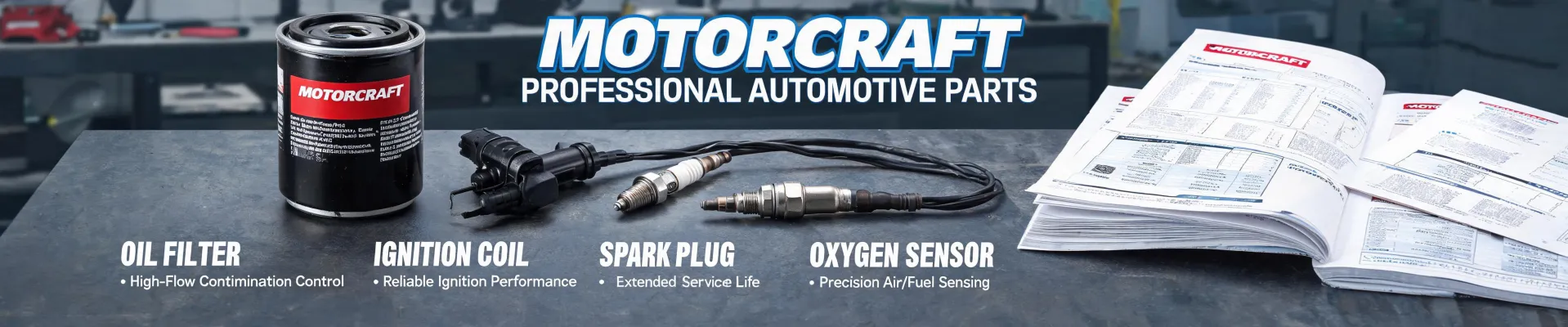
A practical, step-by-step guide for buyers and engineers facing urgent, high-stakes auto part procurement. Learn how to secure Motorcraft filters, transmission fluid, or specialized sensors without losing your shirt.
-
Step 1: Nail Down the Exact Specs (Including the Variations)
-
Step 2: Verify Supplier Stock and Production Capacity Immediately
-
Step 3: Calculate 'Real' Lead Time (Not 'Standard' Lead Time)
-
Step 4: Demand a Delivery Guarantee (And Be Willing to Pay for It)
-
Step 5: Specify the Shipping Method and Carrier
-
Step 6: Confirm the 'What If' Plan (Redundancy)
-
Final Thoughts & Common Mistakes
As a purchasing coordinator for a Tier 2 supplier, I've lost sleep over a lot of things. A critical die breaking down. A customer's line-down situation. A $15k rush order for a 6.7 Powerstroke Motorcraft oil filter that needed to be on a truck in 36 hours, not the usual 5 days.
In my role triaging these emergencies for the last 6 years, I've processed over 200 rush jobs for clients ranging from small repair shops to major assembly plants. There's a specific way to handle this that works almost every time. Here are the 6 steps I follow when the clock is ticking and a wrong part isn't an option.
Step 1: Nail Down the Exact Specs (Including the Variations)
Most buyers focus on the part number. They completely miss the production batch or superseded revisions. That's the big blind spot.
The question everyone asks is, 'Do you have this part?' The question they should ask is, 'Do you have this specific revision, and is it from a current production run?'
For example, say you need a Motorcraft Mercon LV transmission fluid bottle. A standard 'Mercon LV' is usually fine, but if your customer spec requires the long-life formulation from a recent batch (something about a viscosity update in late 2024), the standard shelf stock might be wrong. You need the specific date code.
- Your checklist: Get the OEM part number, the superseded part numbers (if any), and the production date code requirement.
- Don't assume: 'Standard' is rarely standard on a rush job.
Step 2: Verify Supplier Stock and Production Capacity Immediately
Here's something vendors won't tell you: their 'in stock' inventory is often allocated to standing orders. The public facing inventory system is a promise, not a guarantee.
When I needed a Racepak driveshaft sensor for a prototype build (in March 2024, 36 hours before a critical dyno test), I called three suppliers. Two showed it in stock online. Only one had an actual unit not reserved for another customer. The other two would have been a 2-week backorder.
How to verify: Ask directly, 'Is this physically on your shelf, or is it on a purchase order from your supplier?' If it's on a PO, get the inbound date. Don't accept 'Yes, we can get it' as a confirmation.
Step 3: Calculate 'Real' Lead Time (Not 'Standard' Lead Time)
The 'standard' turnaround is often a buffer created by the vendor to manage their production queue. For an urgent Acura RSX headlight bulb or a custom aluminum extrusion, the 'standard' time of 5 days might really be only 2 days of actual work.
The trick: Ask for the 'next possible outbound' date. Not 'how long does it take,' but 'what's the earliest I can have this in my hands?'
For production parts like stampings or forgings, ask for the specific press or die availability. A die that's being set up for a similar job can be swapped in faster than a die that's in a storage rack 3 miles away.
Step 4: Demand a Delivery Guarantee (And Be Willing to Pay for It)
This is the core of the 'time certainty' principle. A cheap, uncertain delivery is a false economy. The delay cost our client their event placement. Missing that deadline would have meant a $50,000 penalty clause.
We once had a $12,000 order for a set of dies. We tried to save $400 on standard shipping. The vendor's 'probably on time' promise turned into a 4-day delay. We lost the production slot. We now pay the premium for guaranteed delivery.
- The markup: Rush premiums for 1-2 day turnaround on parts like Motorcraft oil filters or fluids are typically 25-50% over standard. For custom machined components, it can be 100-200%.
- The decision: Approve the rush fee and immediately thought 'could I have negotiated?' Didn't relax until the delivery arrived on time and correct.
In that case, we paid $800 extra in rush fees (on top of the $2,500 base cost) and saved the $12,000 project. Simple. Done.
Step 5: Specify the Shipping Method and Carrier
Don't leave this to the vendor's default. 'Ground shipping' is not good enough for a Friday afternoon emergency.
In my experience, specifying 'FedEx Priority Overnight by 8:00 AM' vs. 'Next Day Air' can be the difference between having the part for the first shift or the second shift. For a Racepak driveshaft sensor, that 4-hour window was everything.
Your checklist: Ask for the exact carrier, service level, and guaranteed delivery window. Get the tracking number immediately, not 'when it's shipped.'
Step 6: Confirm the 'What If' Plan (Redundancy)
Even after choosing the vendor and paying the rush fee, I kept second-guessing. What if the shipment gets lost? What if the part is the wrong revision?
The risk mitigation: Always confirm the vendor's backup plan. 'If the first shipment fails, what's your process? Do you have a second unit available? Can you drop-ship from a different warehouse?'
For a critical part, ask if they can ship two (if cost is manageable) via different carriers. This sounds excessive, but it's standard practice for prototype builds and line-down situations. The $100 extra for a duplicate part shipped via UPS is cheap insurance against a $10,000 line stoppage.
Final Thoughts & Common Mistakes
Important note: Prices and shipping costs are as of early 2025, based on standard rates and publicly available information. Always verify current pricing with your vendor. This isn't legal advice, just practical experience from a guy who's been burned.
The biggest mistakes I see:
- Not verifying stock: ‘In stock’ online means nothing. Call and confirm.
- Ignoring the revision: A wrong Motorcraft oil filter for a 6.7 Powerstroke will not just be a hassle—it could damage the engine.
- Thinking cheap shipping is a good idea: In a rush, reliability is the product you're buying.
The surprise wasn't the price difference in the end. It was how much hidden value came with the 'expensive' option—support, revisions, and quality guarantees.
About the author

Elise Novak is an automotive braking systems analyst specializing in brake pads, discs, rotors, calipers, shoes, drums, hoses, and complete brake kits. She uses UN Regulation 90 requirements and ISO 26867 dynamometer methods to examine friction stability, fade and recovery, wear, disc thickness variation, runout, and hydraulic integrity. Her work helps distributors, quality teams, and fleet buyers compare replacement parts, verify application suitability, and define incoming-inspection criteria.