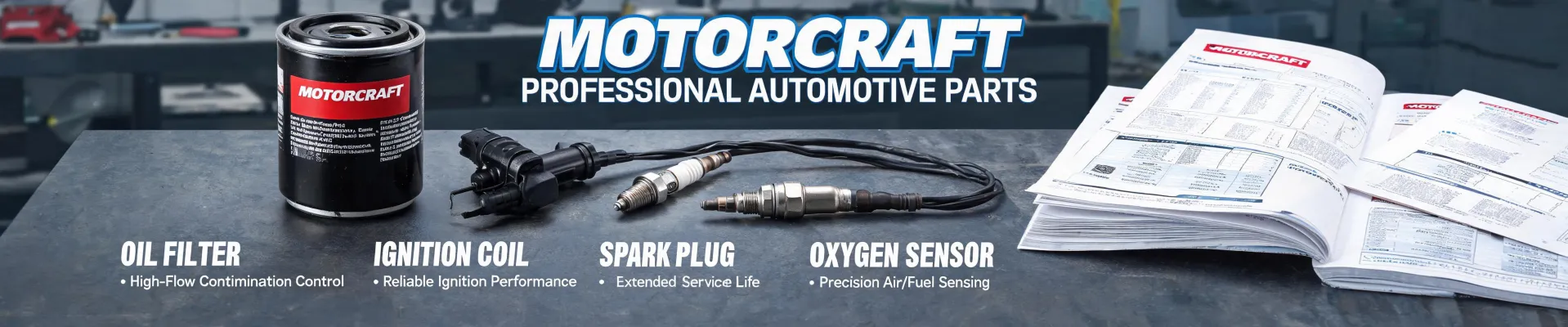
A field guide for fleet managers and parts buyers who need Motorcraft diesel glow plugs, fuel filters, CV joint bearings, or radiators in a hurry. Match your situation to the right sourcing strategy.
There's no honest shortcut answer to the question I get almost daily: "How fast can you get Motorcraft parts to my door?" It depends entirely on the situation. In my role coordinating expedited parts procurement for mid-sized fleet operators, I've handled 300+ rush orders over the past nine years. The pattern is always the same — the right move changes completely depending on whether we're dealing with a vehicle that's dead on the shoulder or a planned maintenance event.
Three Scenarios. Three Different Answers.
The first thing I do when a customer calls with a parts emergency is figure out which of three buckets they're in:
- Scenario 1 — Vehicle down. It isn't moving, and every hour of downtime costs real revenue.
- Scenario 2 — Driveable but not right. Rough running, coolant weeping, drivetrain noise. Needs parts in the next few days.
- Scenario 3 — Scheduled maintenance. The parts go on whenever they arrive. Price is the focus.
Most people try to handle all three the same way: overnight shipping plus expedited fees. That's usually a $150–$200 shortcut that doesn't actually solve anything. Let me walk through what works in each case.
Scenario 1: The Vehicle Is Down. Revenue Stops Today.
In January 2024, a fleet operator called at 6:17 AM. One of their diesel Ford vans wouldn't start in the cold, and the mechanic had already confirmed faulty glow plugs. They needed four Motorcraft ZD-15-2 diesel glow plug units. The temperature was -12°F. Their alternative was canceling eight scheduled service calls.
The cost metric here is not the part price — it's the lost revenue per day. A commercial vehicle that's down is typically $500–$2,000+ per day in missed work. A $25 glow plug is noise in that equation.
Here's the move that surprises most people: call the local Ford dealer parts counter before you open the online ordering tab. Not because the dealer's list price is exciting — a Motorcraft ZD-15-2 typically lists for $25–$35 at the counter (verify current pricing) — but because the dealer can search regional warehouse stock in real time and put the part on a same-day truck. Overnight air from an online discount seller usually costs $30–$50 in shipping, and it still lands tomorrow instead of today.
The same logic applies to a Motorcraft diesel fuel filter. If a truck is running rough because the filter is clogged with winter wax or water, the right filter — an FD-4613 or whatever your manual specifies — from a dealer's shelf fixes it before lunch. Discount online pricing saves maybe $10–$15 after shipping. That's not worth a day of downtime.
One caveat from painful experience: dealer same-day capability has limits. Check stock first, then have a backup plan. A Saturday morning glow-plug failure with a closed parts counter is how I ended up personally driving forty miles round-trip to a distributor. I do not recommend that as a strategy. But it was still cheaper than the alternative.
Scenario 2: Driveable, But Not Right.
Now let's talk about the gray zone where I see the most overspending. The vehicle runs, but the CV joint bearing is starting to hum at highway speed. The radiator is weeping from the end tank. The fuel filter is borderline. This is real, but it's not an emergency — yet.
My honest answer: you've got 2–5 days, so use them to get the right part at a fair price instead of paying panic premiums.
This is where the standard advice actually works. Authorized online Motorcraft parts retailers and established distributors can get you a genuine diesel fuel filter in the $30–$60 range, depending on the model (based on public listings, January 2025 — verify current rates). That's often 15–25% below dealer walk-in pricing, and 2–3 day ground shipping fits your window.
The key phrase is genuinely driveable. A CV joint bearing that just started humming? Probably fine for another 500–800 miles. A radiator that's actively dripping coolant? That's not a 3-day problem. Coolant loss accelerates fast. If the drip gets worse, you're back in Scenario 1 with less time to think.
Every week, someone asks me "how much is a car radiator?" Here's the honest comparison, based on what my customers see when I quote them (public distributor pricing, 2025 — verify before ordering):
- Aftermarket radiator for a Ford F-Series: $100–$180
- Motorcraft radiator: $220–$400
- Installation labor at typical shop rates: $250–$500
The part price gap looks enormous until labor is added. And labor is where the advantage of an OEM-spec part shows up. In my experience, the Motorcraft unit installs without bracket fighting, without re-drilling, and without a return trip. That's the whole game when shop labor runs $120–$150 an hour. I'd rather hand a customer a $280 radiator invoice than see the same vehicle back on the lift six months later.
Scenario 3: Scheduled Maintenance. Use the Time.
If you know the CV joint bearings are due next quarter and the diesel fuel filter is on the maintenance schedule, you have the luxury of shopping properly.
This is the sweet spot for price comparison. Get quotes from two or three authorized distributors. Ask about fleet pricing. Buy multi-unit quantities if you're maintaining several trucks on the same platform — glow plugs and fuel filters are consumables; you will use them.
While you're at it, check your manual's schedule for differential service. Ordering diff fluid alongside the bearings and seals saves a second freight charge.
My internal data from the last four quarters says the gap between expedited and planned parts procurement is roughly 25–30% in shipping and rush premiums alone. For a shop maintaining even ten diesel pickups, that's real money — a no-brainer to fix by planning better.
How to Tell Which Scenario You're In
I use three questions when a client tells me they "need parts fast":
- Is the vehicle making money today? If the answer is no — it's already down — you're in Scenario 1. Stop price-shopping and start calling dealers.
- Will it still make money tomorrow? If the vehicle can finish its current assignments safely, you've got 2–5 days. Use an authorized online source with standard ground shipping.
- Can this wait until next month? Then it's scheduled maintenance. Build quotes, compare distributor pricing, and buy ahead of the season.
The bottom line: most parts "emergencies" are actually Scenario 2. A weird noise or a slow weep makes people believe the vehicle is about to explode, but a methodical check of the timeline almost always reveals a 3-day window. The extra time is worth 20% or more in parts cost.
But I'll say this honestly: the day you stand in a freezing lot watching a diesel van refuse to start after a glow plug replacement, the last thing you want to hear is a lecture about sourcing efficiency. Sometimes you just need the part on a shelf. That's where the dealer-and-distributor relationships matter more than any price comparison tool, and it's why I keep both — the efficient online pipeline for planned work and the phone list for the cold mornings.
I have mixed feelings about those rush fees, honestly. Part of me resents paying a premium for what's basically logistics stress. Part of me understands that the people scrambling to get me a part at 7 AM on a Saturday are doing real work. But that's a conversation for another time. For now — figure out which scenario you're in, and source accordingly.
About the author

Elise Novak is an automotive braking systems analyst specializing in brake pads, discs, rotors, calipers, shoes, drums, hoses, and complete brake kits. She uses UN Regulation 90 requirements and ISO 26867 dynamometer methods to examine friction stability, fade and recovery, wear, disc thickness variation, runout, and hydraulic integrity. Her work helps distributors, quality teams, and fleet buyers compare replacement parts, verify application suitability, and define incoming-inspection criteria.