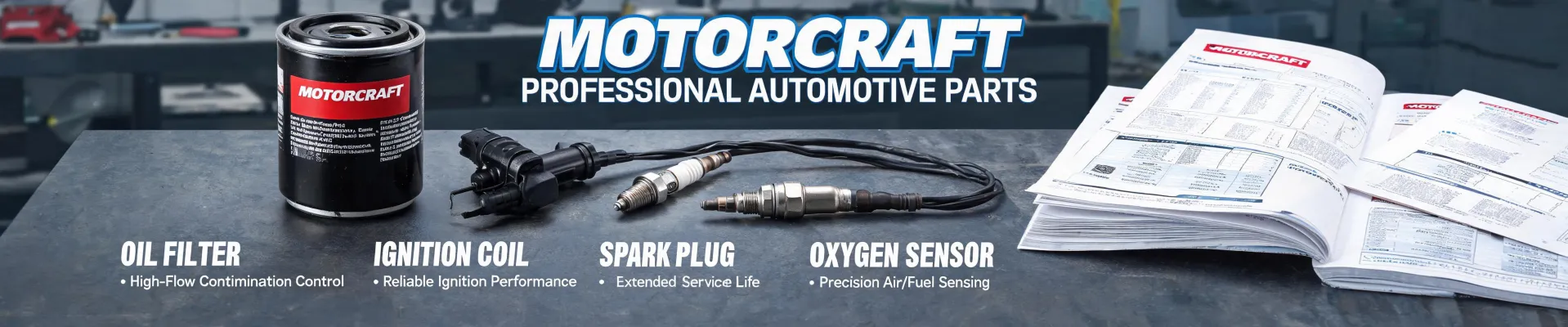
A procurement veteran explains why budget parts often fail when it matters most—covering 6.0 Motorcraft fuel filters, brake master cylinder covers, NTK oxygen sensors, and the real difference between upstream vs downstream O2 sensors.
Last December, a customer called at 2 p.m. with a line-down emergency. They needed twenty-four brake master cylinder covers by 7 the next morning. The right cover wasn't the problem—it was that the “value” batch they'd bought three weeks earlier didn't seat properly. Brake fluid was weeping onto the master cylinders, and nobody wanted to ship a product smelling like a liability.
So I spent the rest of that afternoon and a good chunk of my evening sourcing the Motorcraft BRFC-6 covers, paying next-day air freight on a part that should've been a no-brainer. The customer saved maybe $3 a piece on those cheap covers. The rush freight alone ate that saving ten times over.
That's the thing about auto parts: the price tag is the beginning, not the end. And honestly, after a decade-plus of doing this, I'd rather explain an emergency than cause one.
The Real Problem Isn't Price. It's Everything After Price.
When I first started buying parts for manufacturing and fleet customers, I assumed that if the part number matched, the cheapest option was the smartest option. It took two expensive lessons to unlearn that: once with a batch of “compatible” fuel filters for a 6.0 Power Stroke, and once with an oxygen sensor that turned a routine tune-up into a diagnostic circus.
Here's the deeper issue, and most buyers don't think about it until they've been burned: parts that look the same aren't always made the same. The plastic in a cover, the filtering media in a fuel filter, the internal wiring in an O2 sensor—these are engineering decisions. A low-cost supplier can and will change materials to hit a price target. The part still fits, usually. But “usually” is not a specification.
Let's Talk About the 6.0 Motorcraft Fuel Filter
The 6.0 Power Stroke is a great engine, but it's sensitive to fuel pressure and injector health. The Motorcraft fuel filter is designed per Ford engineering requirements with a specific micron rating and bypass pressure, and it keeps water and debris out of the high-pressure fuel system. A bargain filter might look the part, but if the media collapses or the bypass opens too early, you get fuel starvation, injector damage, or worse.
Last quarter alone, we saw nearly a dozen rush orders for 6.0 fuel systems that started with a $15 filter “deal.” The replacement injectors cost more than a thousand dollars. The filter that caused it? Warranty denied. The time lost? Incalculable.
And the Motorcraft Brake Master Cylinder Cover BRFC-6
It's just a cap. How hard can it be? That's what I used to think. But a brake master cylinder cover has to keep moisture and dust out of the brake fluid. Brake fluid is hygroscopic—it absorbs water. If the cover doesn't seal properly, the fluid gets contaminated, the boiling point drops, and you're looking at corrosion and degraded braking over time.
I have mixed feelings about aftermarket caps. Some are genuinely fine, and I've used them. But when one warps under hood heat—and I've seen it happen—it stops being about a $5 part. Now it's about brake safety and your reputation.
Upstream vs Downstream O2 Sensors: Know Which One You Need
Oxygen sensors are another classic “just needs to fit” part, and that's a trap. Here's the difference:
An upstream O2 sensor sits before the catalytic converter. It measures oxygen in the exhaust to help the engine computer manage the air-fuel mixture in real time. A downstream O2 sensor sits after the catalytic converter and monitors converter efficiency. They look similar, but the signals they send are different.
Put a downstream sensor in the upstream position, and your engine will run rich or lean—pushing fuel economy down and emissions up. According to the U.S. Department of Energy, a faulty oxygen sensor can reduce fuel economy by up to 40%. That's not a rounding error. That's a customer who notices the gas gauge moving faster.
When you're buying a sensor, always confirm the exact position and application. If a supplier recommends an NTK sensor—which is generally a solid brand—make sure the part number, like 24473, is actually listed for your vehicle's position. I'm not knocking NTK or any other brand. I'm saying you have to check application data instead of assuming. The same goes for any sensor, regardless of brand.
The Expensive Side of “Cheap”
Let's quantify this. A no-name oxygen sensor might save you $30. If it fails or sends the wrong signal, that's at least an hour of labor—$100 to $150—plus a scan tool fee, plus customer downtime. A cheap brake master cylinder cover that warps could cause a brake fluid leak and turn into a liability claim. A poorly made fuel filter could ruin an injector set and kill a diesel engine's performance.
When I look at our internal data from more than 200 rush orders, a pattern jumps out: most emergencies are not caused by missing parts. They're caused by wrong parts—parts that were bought to save money and didn't perform. The cost isn't just the replacement part. It's the expedited shipping, the overtime labor, the lost production, and the hit to your credibility when you're called out.
So What Should You Do Differently?
Simple rule: before you order a cheap version of a critical part, ask yourself what the cost of being wrong is. If that answer includes “hours of labor” or “missed deadline,” or if the part is safety-related, buy the known-good option.
That doesn't mean every premium part is worth every premium. It means you buy based on total cost of ownership, not sticker price. Keep a list of critical applications—fuel system, brake system, emissions, steering. For those, stick to brands with documented OE specifications, like Motorcraft for Ford applications. If you need a performance muffler, something like a Flowmaster unit is a popular choice and can be great, but check hangers, pipe diameter, and fitment ahead of time—an exhaust leak near an O2 sensor can cause false readings and make a straight upgrade into a frustrating mystery.
Most importantly, build relationships with suppliers who can answer the “what's it for” question and show documentation. A supplier who offers evidence, not just a price, is the supplier who'll help you avoid emergency purchases in the first place.
I've kicked myself more than once for going cheap on a part that I absolutely knew better about. The worst one was a late-night decision on a sensor because the customer was in a hurry. It cost us a return visit, a customer's trust, and a weekend. If I've learned anything, it's this: the most expensive part is the one you buy twice.
And when that voicemail comes in at 2:15 p.m., you want to be the person who can say, “I know exactly which part you need, it's already on the shelf, and it's the right one.” That's how you avoid the emergency—or at least make it unremarkable.
About the author

Elise Novak is an automotive braking systems analyst specializing in brake pads, discs, rotors, calipers, shoes, drums, hoses, and complete brake kits. She uses UN Regulation 90 requirements and ISO 26867 dynamometer methods to examine friction stability, fade and recovery, wear, disc thickness variation, runout, and hydraulic integrity. Her work helps distributors, quality teams, and fleet buyers compare replacement parts, verify application suitability, and define incoming-inspection criteria.