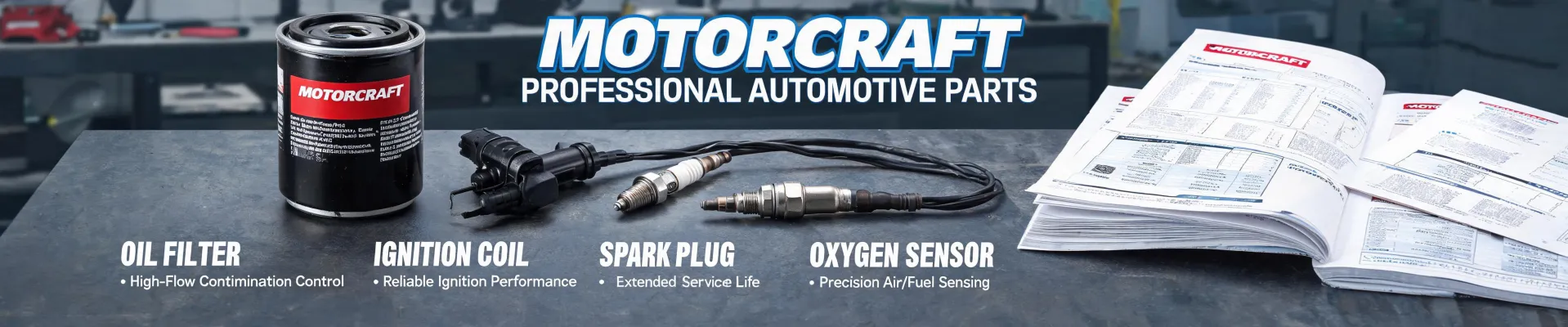
How to decide between Motorcraft parts and cheaper alternatives for timing chains, thermostats, radiator repair, and headlight services—based on real cost-tracking experience.
There's no single right answer to whether you should buy Motorcraft parts or save money with cheaper alternatives. It depends on the vehicle, the part, and your own risk tolerance. After 7 years of managing a $320,000 annual repair budget for a small logistics fleet, I've sorted through hundreds of invoices and compared parts in every price range. The bottom line: the cheapest option is sometimes the right call—and sometimes it's a trap.
Here's what you need to know: the decision isn't about brand loyalty. It's about matching the repair to the situation. Let me show you how.
Three Scenarios, One Budget
In my experience, most repair decisions fall into one of three buckets. Each has a different part-buying strategy.
Scenario A: The One-More-Winter Car
If you're driving a car worth maybe $2,500 and you just need it to survive until next year, a full OEM parts catalog doesn't make sense. You're not preserving an asset; you're renting time.
For non-critical parts—alternators, window regulators, headlight housings—buy the budget option. No one needs a $350 OEM window motor for a car they'll scrap in 18 months.
But for critical engine components, I've learned to be careful. A motorcraft timing chain kit is about $280–$350 (ballpark; prices vary by engine) while a no-name kit might be $120. If the timing chain breaks, it can destroy the engine—potentially a $4,000 repair. On a $2,500 car, that's not a risk I'd take.
The anti-intuitive advice here is: still spend the extra money on the timing chain kit. You're already paying labor—don't make the shop redo it. I watched a buddy install a cheap timing kit in a beater; 3,000 miles later the tensioner failed and bent two valves. The so-called savings turned into a $900 screwdriver session.
I'll admit, even after I recommended a $320 Motorcraft kit to my brother-in-law for his old Explorer, I kept second-guessing. What if the cheap one was fine? The first few mornings I held my breath, waiting for a grinding noise. (Thankfully, it started clean.) But after hundreds of repair orders, I've stopped gambling on parts that require engine teardown to replace.
Scenario B: The Keep-It-Dependable Vehicle
If your car is relatively new, still under warranty, or you rely on it for work, you want original-quality parts. This is where Motorcraft makes sense.
Take the Motorcraft RT1203 thermostat. It's a simple part, maybe $30–$40 list. The aftermarket knockoff might be $12. Seeing the two side by side made me realize why the extra $20 is worth it. The OEM unit has a properly seated rubber gasket and a metal valve; the cheap one had a plastic flap that looked sticky. A stuck thermostat can cause overheating and, worst case, a blown head gasket—a repair that costs ten times more than the part.
On newer cars, even the thermostat matters. You don't want a $12 part to cause a $1,000 repair. And if you're keeping the car for the long haul, the premium is spread out over years of use.
Same for the timing chain. A motorcraft timing chain kit for a Ford EcoBoost is more expensive than aftermarket, but the kit includes all the guides, tensioners, and seals—not just the chains. I've seen complete kits from other brands miss a camshaft seal, forcing a second teardown and an extra $200 in labor. That's a deal-breaker.
Scenario C: The Let-a-Pro-Do-It Repair
Some repairs are better left to professionals, even if you're handy. Headlight repairs services, for example, can be simple bulb swaps—unless your car requires removing the bumper or dealing with sealed units. If you've ever spent an hour contorting your arm into a wheel well to reach a headlight bulb, you know why a $75 shop charge starts to look reasonable.
Similarly, radiator repair in Grayson—or wherever you live—might be cheaper than replacement. A skilled radiator shop can often solder a leaking core for $200, while a new radiator plus labor runs $600+. The catch: it only makes sense if the radiator isn't cracked beyond repair. A quick pressure test is worth the money before you decide.
And if you're someone who's asking where is a head gasket located—that's a red flag. The head gasket sits between the engine block and the cylinder head, sealing combustion pressure and coolant channels. When it fails, you might see milky oil or coolant bubbling in the overflow tank. Replacing it means tearing down the top end: easily a $1,500–$2,500 job. That's not a DIY weekend project, even with a YouTube video.
In this scenario, the cost-saving move isn't buying a cheaper head gasket kit. It's deciding whether the car is worth fixing at all. If it's a 12-year-old car with 180,000 miles, a head gasket repair may exceed the car's value. My rule: if a repair costs more than half the car's worth, seriously consider walking away.
How to Know Which Scenario You're In
Still on the fence? Fair enough. The lines blur. Here's how to decide quickly.
- What's the car's value? If you'd get less than $3,000 on a trade-in, you're in Scenario A. If it's more than $10,000, Scenario B. In between? Decide based on your plans.
- How long do you plan to keep it? More than three years? Lean toward original parts. Under a year? Budget parts are fine for non-critical stuff.
- How much do you hate breakdowns? If you can't miss work or carry a newborn in that car, don't gamble with unknown aftermarket parts. That's a no-brainer.
This sounds obvious, but it took me 7 years and about 400 invoices to internalize it. It's not about brand loyalty; it's about total cost, including your time and risk.
Honest Limitations
Before you take any of this as gospel, know what this guide isn't. It's not for luxury or high-performance vehicles. If you drive a BMW M4 or a Ford Mustang Shelby, the calculus is different—you're paying for precision and driving experience, not just transportation. And it's not a blanket endorsement of Motorcraft. I've bought plenty of aftermarket parts that worked perfectly. The point is to match the part to the vehicle's remaining service life, not to blindly follow a brand.
Also, prices I've mentioned are accurate as of March 2025, at least in my area. The market changes fast, so verify current prices before you budget.
The Bottom Line
The cost of a part is not just the part price. It's the part price plus the cost of failure.
There's no universal rule for buying Motorcraft or aftermarket parts. For aging cars, save money on non-critical items but don't cheap out on the timing chain. For newer cars, original parts like the Motorcraft RT1203 thermostat are worth the premium. And for big repairs like radiator or head gasket work, step back and ask yourself whether the car is worth fixing at all.
The best purchase isn't always the cheapest part or the priciest—it's the one that fits your specific situation. Buy according to that, and you'll keep your car on the road without burning cash.
About the author

Elise Novak is an automotive braking systems analyst specializing in brake pads, discs, rotors, calipers, shoes, drums, hoses, and complete brake kits. She uses UN Regulation 90 requirements and ISO 26867 dynamometer methods to examine friction stability, fade and recovery, wear, disc thickness variation, runout, and hydraulic integrity. Her work helps distributors, quality teams, and fleet buyers compare replacement parts, verify application suitability, and define incoming-inspection criteria.