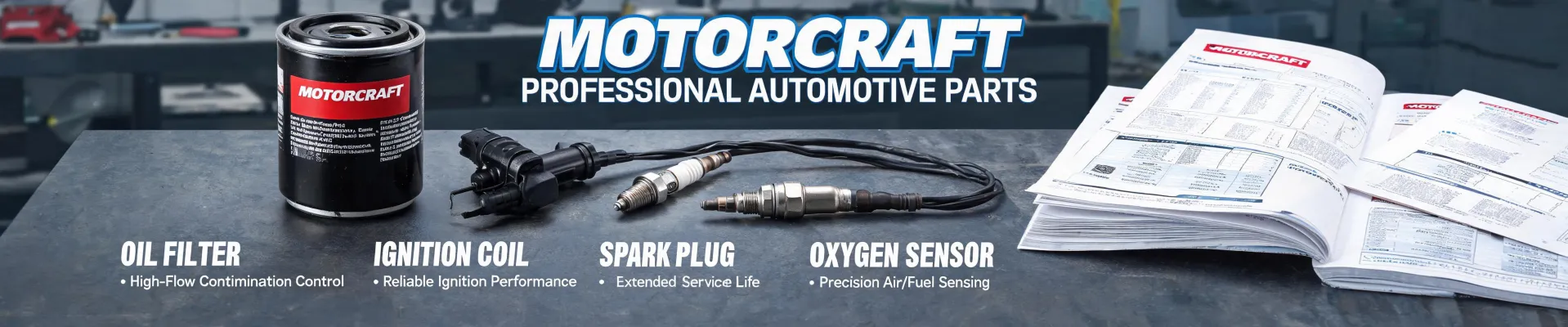
A fleet purchasing administrator compares Motorcraft vs aftermarket spark plugs, oil filters, alternators, and catalytic converters for Ford trucks and SUVs.
If you've ever ordered spark plugs for a 2010 Ford F-150 5.4L, you know the first question isn't price. It's 'will these actually match the factory spec?'
I'm an office administrator for a 130-person logistics company. Since 2021 I've managed the parts buying for our vehicle-maintenance program, roughly $280,000 a year across 12 vendors. I report to operations and finance, so every purchase decision gets looked at twice. This is my honest comparison of Motorcraft vs. aftermarket parts. The short version: neither one is always right.
I'm not comparing Motorcraft to no-name knockoffs. That's an easy conversation. I'm comparing it to established aftermarket brands like Bosch, Denso, and WIX. The real question is when the premium is worth paying, and when it's just fear, not logic.
The comparison framework
I use three dimensions for any replacement part: fit, total cost, and failure predictability. Those three factors decide whether an aftermarket part saves money or just moves the cost to the next breakdown.
Dimension 1: Fit and friction on the 5.4 Triton
The 2010 Ford F-150 5.4 spark plugs Motorcraft sells are not exotic plugs. The difference is consistency. When I compared a Motorcraft plug with a premium aftermarket plug side by side, the thread length matched and the gap was correct on both. But the ground electrode design wasn't identical. That doesn't mean the aftermarket plug failed. It means the failure pattern was less predictable if the engine tune wasn't perfect. On a 5.4 Triton, I don't want 'probably fine.'
The event that changed my thinking happened in March 2023. A supplier subbed in an aftermarket ignition coil because the Motorcraft coil was backordered. The truck misfired within 32 miles. That wasn't a bad product necessarily; the coil just wasn't calibrated the same way. Since then, I've compared parts on the bench, not just on paper.
Oil filters tell a similar story. The 2013 Ford Explorer oil filter Motorcraft supplies has an anti-drainback valve that behaves differently after a week of sitting. We tested three brands on a 3.5L V6: cold-start noise, oil pressure, and filter media after 5,000 miles. The Motorcraft filter held oil in the housing longer, which meant shorter cold-start clatter. Is that worth a $4 premium? For our northern winter fleet, yes. For a southern passenger car, maybe not.
To be fair, WIX and Denso make perfectly good filters. On most vehicles, you'd never notice. But on an Explorer with variable timing components, oil pressure doesn't have a margin for 'close enough.'
Dimension 2: The alternator cost trap
Whenever finance asks why I am not buying the cheaper reman, I point to the phrase 'alternator replacement cost average.' As of January 2025, RepairPal's national range for alternator replacement is around $500 to $700, parts and labor. On a 2010 Ford F-150 5.4, a Motorcraft reman alternator runs about $210 to $260. A quality aftermarket reman runs $120 to $180. Labor is roughly the same in both cases, usually $160 to $220. So the total is only $80 to $100 apart. That's not the margin that makes a vendor switch look smart.
Here's the part that surprised me. I expected the Motorcraft alternator to last at least twice as long. In one backup truck, a Bosch reman lasted 26 months with no trouble. If that truck were non-critical, aftermarket would have been the right call. But in our primary fleet, the one aftermarket unit we installed failed at 14 months with no warning—no dimming lights, no noise, just a dead truck and a tow bill. Combined with the tow and the second labor charge, that 'savings' disappeared.
Even after I chose Motorcraft for the core fleet, I kept second-guessing. What if the aftermarket units were just as good and the failure was random? The first 90 days were stressful. I didn't relax until I saw the pattern across 14 trucks: Motorcraft failures, when they happened, were more predictable. Predictability has a procurement value, even if it doesn't show up on the invoice.
Plus, the on-paper difference misses a practical detail: warranty handling. Some aftermarket alternators carry a limited warranty, but the labor reimbursement is harder to get. You pay to install it, then you pay to file a claim. Buyers who ignore that are comparing part price, not total cost.
Dimension 3: Catalytic converters, precious metals, and market risk
Emissions parts are a different animal. The automotive catalytic converter market has gotten harder to buy in because replacement demand is split between legitimate repairs, theft replacements, and performance upgrades. That split creates a lot of inventory variability. A cheap converter might bolt on, but that doesn't mean it will pass an OBD readiness monitor.
To answer the direct question: how much platinum is in a catalytic converter? A typical gasoline converter on a full-size Ford truck contains around 3 to 6 grams of platinum-group metals, with palladium and rhodium mixed in. The combined precious-metal load usually falls in the 3 to 7 gram range. With platinum near $1,000 per ounce as of February 2025, the scrap value is real. That is why theft is such a problem and why unregulated used converters are a gamble.
I'm not going to say all aftermarket converters are bad. Some direct-fit units are legal, certified, and fine for the right vehicle. But the replacement decision should include labor risk and emissions compliance, not just the price of the metal. If a converter has to come off twice because the check-engine light came back, the cheap part stopped being cheap two hours into the job.
What was best practice in 2020 may not apply in 2025. That is true in most of the parts market. But the fundamentals have not changed: spec traceability, warranty handling, and failure predictability still decide which part is actually cheaper.
So what should you buy?
If the vehicle has to be ready every morning, I lean Motorcraft for the 2010 Ford F-150 5.4 spark plugs, the 2013 Ford Explorer oil filter, and alternators on trucks that can't be down. The extra cost is a reliability fee.
If the vehicle is a spare, a short-term asset, or a low-mileage unit, a quality aftermarket brand with a warranty and a clear spec sheet is a reasonable choice. Denso is not a punishment. WIX is not a scam. They are just different risk profiles.
Bottom line: Motorcraft reduces variance. Aftermarket reduces price. On a spreadsheet, aftermarket looks better. In a breakdown lane, it doesn't. Take it from someone who has explained both to finance.
About the author

Elise Novak is an automotive braking systems analyst specializing in brake pads, discs, rotors, calipers, shoes, drums, hoses, and complete brake kits. She uses UN Regulation 90 requirements and ISO 26867 dynamometer methods to examine friction stability, fade and recovery, wear, disc thickness variation, runout, and hydraulic integrity. Her work helps distributors, quality teams, and fleet buyers compare replacement parts, verify application suitability, and define incoming-inspection criteria.