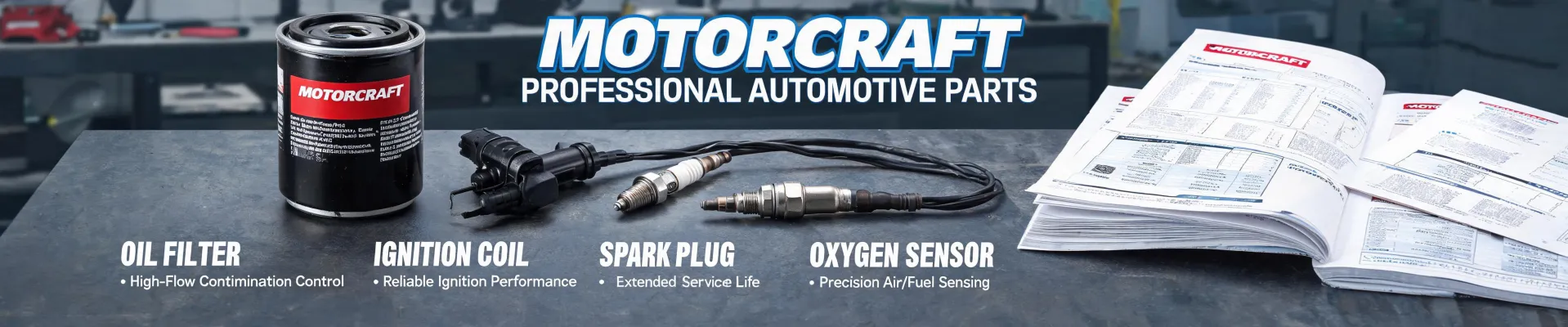
Motorcraft or aftermarket parts? A total-cost comparison covering Motorcraft transmission fluid XT-10-QLVC, engine camshaft position sensors, a 2018 Traverse catalytic converter, and more.
-
Should You Buy Motorcraft or Aftermarket Parts?
-
1. Upfront Price: The Sticker Price Always Looks Like the Whole Story
-
2. Availability: What Is a Part Worth When the Clock Is Loud?
-
3. Fit, Calibration, and Data: Why 'It Bolted On' Is Not Enough
-
4. Warranty and Failure Risk: The Part They Replace Might Not Be the Part They Replace
-
5. Decision Guide: When Motorcraft Makes Sense, and When Aftermarket Is Fine
-
Final Total-Cost Thought
Should You Buy Motorcraft or Aftermarket Parts?
I'm the person who gets called when a vehicle has to be back on the road yesterday. I coordinate rush parts orders for a fleet repair shop, and in six years I've handled more than 200 jobs with hard deadlines. If you're a fleet buyer, a service manager, or just someone who doesn't want to explain a missed delivery, this comparison is for you.
The question everyone asks is simple: Should I buy Motorcraft or the aftermarket part? The useful answer isn't a brand loyalty speech. It's a total-cost comparison. Upfront price is one number. The cost of being wrong is another.
Here's what I compare on every rush order:
- Upfront price
- Availability and lead time
- Fit, calibration, and data
- Warranty and failure risk
- Total cost over 1-2 years
One note before the comparison: Motorcraft is Ford's OE brand. If you're looking for a 2018 Traverse catalytic converter, the OE equivalent is ACDelco, not Motorcraft. The logic is the same, and I'll flag it where it matters.
1. Upfront Price: The Sticker Price Always Looks Like the Whole Story
Let's start with the number most people look at first.
A Motorcraft engine camshaft position sensor can cost $85 or more depending on application. A budget sensor for the same engine is often around $25. Motorcraft transmission fluid XT-10-QLVC is about $11 per quart at Ford dealers as of January 2025 (based on Motorcraft.com and dealer quotes; verify current rates). A no-name 'multi-vehicle' ATF might be $6. For a 12-quart transmission flush, that's roughly $132 versus $72. On paper, the aftermarket parts save $60 to $100 per job.
Here's what I've learned comparing quotes side by side: the savings on the shelf often disappear in the service bay. The $25 sensor is only a good deal if it does the same job for as long. If it sets a check-engine light after three weeks, you're not changing the part, you're changing the part and paying for another hour of labor.
Let's get the fuel pump definition out of the way: a fuel pump is the electric pump that moves fuel from the tank to the engine. A cheap fuel pump that can't hold pressure makes the engine crank for an uncomfortably long time before start, then maybe runs fine, then leaves you dead at the worst possible time. That isn't a $30 problem. That's a tow truck problem.
2. Availability: What Is a Part Worth When the Clock Is Loud?
Sometimes the aftermarket wins on speed. A house-brand sensor on the shelf can be on the car in an hour. A Motorcraft sensor might have to come from a dealer 40 miles away.
In March 2024, a client called at 4:15 PM. Their Mustang had to be at an event by 10 the next morning, and the camshaft position sensor was dead. The local chain store had a generic sensor in stock for $18. The Motorcraft sensor was 40 miles away at a dealer. We paid a courier $75, plus the $90 sensor, and had it installed by 9 PM. The generic part would have been on the car in 30 minutes.
Was that a waste of money? No. The client's contract had a $3,500 penalty clause for missing the event. The risk wasn't the $18 part; the risk was the one-in-ten chance it failed at the show. Based on our internal data from 200+ rush jobs, a cheap sensor that sets a code during the final test drive eats the savings and then some. (Note to self: always schedule the final test drive, even if it means the customer waits five extra minutes.)
The same logic applies to a 2018 Traverse catalytic converter. The OE replacement is ACDelco, and it can cost $1,000+ before labor. An aftermarket converter may be $400 and in stock. But if you're in a state with emissions inspection, a converter without the right approval can be a legal problem, not just a money problem. (Verify current regulations at arb.ca.gov if you're in California.)
Availability isn't just about what's in stock. It's about what happens if the part doesn't work. A $400 aftermarket converter that throws a code and fails inspection needs to be swapped again. The second labor bill is the hidden lead time.
3. Fit, Calibration, and Data: Why 'It Bolted On' Is Not Enough
This is where the comparison stops being about price and starts being about engineering.
A camshaft position sensor doesn't just tell the engine the cam is spinning. It sends a precise signal that the PCM uses to time the engine. When I looked at a Motorcraft sensor next to a cheap one side by side, they looked identical. Same connector, same thread pitch. But I finally understood why they weren't: the OEM sensor had proper internal shielding and a more precise magnetic receiver. The cheap one wasn't sending the same data. It was just pretending to.
The repair order tells the story. We replaced a cheap sensor with a Motorcraft engine camshaft position sensor on a Ford, and the P0340 code went away. The generic part had failed within 50 miles. That's not a brand myth; that's a signal-quality problem.
Transmission fluid is even worse because all fluid looks the same from the outside. Motorcraft transmission fluid XT-10-QLVC is Mercon ULV, designed for 10R80 and 10L90 10-speed transmissions, according to Ford's Motorcraft fitment data. A universal ATF can be the right viscosity but the wrong friction characteristics. I've seen a truck shift fine when cold and shudder when hot because someone used a 'compatible' fluid. The correction was another flush, new fluid, and a day of lost revenue.
Let me be clear: this isn't 'OEM is perfect.' I've seen aftermarket parts work fine. But for a part that lives deep inside an engine or transmission, the calibration risk is real.
4. Warranty and Failure Risk: The Part They Replace Might Not Be the Part They Replace
Warranty language confuses people. Most Motorcraft parts sold by authorized dealers carry a two-year replacement warranty on many components, but you should check current terms before assuming. The cheap aftermarket sensor often comes with a 90-day replacement warranty. That sounds okay until you remember: the warranty covers the part, not the labor.
In my first year, I made the classic rookie error: I approved a budget sensor to save a customer $50. It came back on a tow truck two weeks later. The failed sensor didn't just ruin the trip; it made the customer wonder about every repair we'd done. The $50 savings cost far more in customer trust.
That's why total-cost thinking matters. A failed fuel pump can make the engine run lean and damage a catalytic converter. So if someone quotes you a great price on a 2018 Traverse catalytic converter, the first question shouldn't be about the converter. It should be: what caused the original to fail? If it was a misdiagnosed fuel pump or misfire, the new converter will suffer the same fate.
That's also where the 'cheap part' gets expensive. A failing fuel pump is hard to identify without a fuel pressure test, and the failure mode can be intermittent. If it only delivers pressure sometimes, the whole fuel system pays the price.
5. Decision Guide: When Motorcraft Makes Sense, and When Aftermarket Is Fine
Here's the bottom line. This isn't a universal 'always buy OEM' argument. It's about total cost.
- Buy Motorcraft (or the vehicle's OE brand) when: the part is critical to engine timing, transmission operation, or emissions; the vehicle has a hard deadline; or the labor to replace the part twice is high.
- Aftermarket is fine when: the part is non-critical, easy to replace, or the risk of failure doesn't create a bigger repair. Wiper blades, trim pieces, and some suspension parts are examples.
- If you're on the fence: ask one question. How much does the second failure cost? If the answer is more than a month of payments, go with the part with the verified spec.
The cheapest part is the one you pay for once. The expensive one is the one you pay for twice.
And if you're here because you also need to know how to change air filter in house, here's the short version: turn off the furnace, pull the old filter out, check the air flow arrow, slide the new filter in the same direction. Do it every one to three months. It's the same logic: a $12 filter is cheap. A blower motor or coil repair is not.
Final Total-Cost Thought
The next time you compare a Motorcraft transmission fluid XT-10-QLVC, a Motorcraft engine camshaft position sensor, or any critical replacement part, don't just ask which one is cheaper. Ask which one is cheaper to be wrong. For critical drivetrain parts, Motorcraft is often a no-brainer—not because the brand is magic, but because the cost of being wrong is too high.
That's the comparison that actually matters.
About the author

Elise Novak is an automotive braking systems analyst specializing in brake pads, discs, rotors, calipers, shoes, drums, hoses, and complete brake kits. She uses UN Regulation 90 requirements and ISO 26867 dynamometer methods to examine friction stability, fade and recovery, wear, disc thickness variation, runout, and hydraulic integrity. Her work helps distributors, quality teams, and fleet buyers compare replacement parts, verify application suitability, and define incoming-inspection criteria.