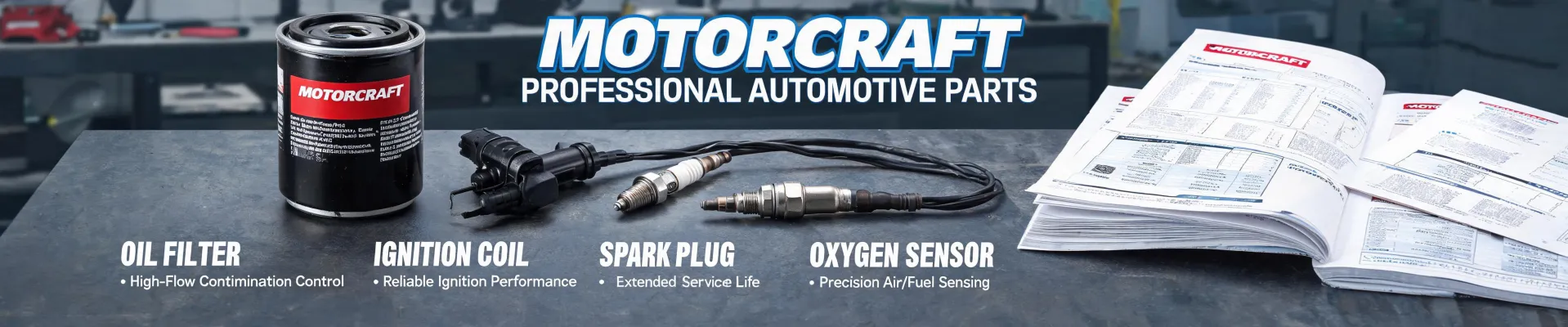
The $45 'direct replacement' shock absorber that cost $900: a quality inspector shares what a 12mm spec difference taught him about Motorcraft parts.
A Tuesday evening text can change your entire week.
This one was from Mike. He runs a landscaping crew—three trucks, fifteen employees, and a maintenance schedule best described as "reactive." He's also, somehow, someone I've spent a lot of Saturday afternoons helping.
"The F-150 is shaking again. Think those cheap shocks we put on last year are bad?"
I remembered the shocks. Of course I remembered the shocks.
Mike bought two "direct replacement" front shock absorbers online last year at $45 each. The listing said they matched the Motorcraft ASH-23463 front shock absorber: same stroke, same valving, same mounting points. "Direct replacement." That phrase should have raised more flags than it did.
Here's something vendors won't tell you: "direct replacement" means the part is designed to bolt up. It doesn't mean it performs like the original. And "same specifications" on a product page doesn't mean the manufacturer actually engineered to those specifications.
Twelve Millimeters
When the shaking started, Mike didn't suspect the shocks. Why would he? They were practically new. He spent $110 on a four-wheel alignment that didn't solve anything. Then $350 on a wheel bearing replacement that didn't solve anything either. Then he called me.
I brought the truck into our verification bay after hours—one of the benefits of being the quality compliance manager at a precision automotive components company. It took about thirty seconds on the lift. The passenger-side shock was leaking fluid, and when I pushed down on the front bumper, the suspension came back with a dull, sloppy bounce that told me everything.
I pulled the shock and measured it against our spec documentation for the Motorcraft ASH-23463. The bolt spacing was fine. The bushings were fine. But the compressed length was 12 millimeters shorter than the Motorcraft spec, and the internal piston diameter was smaller.
Twelve millimeters. Half an inch, give or take.
That difference matters because it changes where the piston sits during normal ride height. Instead of floating in the middle of its stroke, the piston rides closer to the end, and the seal band is loaded in a way it wasn't designed for. The seal wears. The seal fails. In Mike's case, it failed in four months.
The math afterward was ugly. $90 for the shocks that failed. $110 for the alignment that wasn't needed. $350 for the wheel bearing that was never the problem. $300 for a proper pair of Motorcraft replacements. That's $850, give or take, to fix a problem caused by a $45 part.
In my day job, I review roughly 1,200 parts a month before they go out to customers. In our Q1 2024 audit, we rejected 6% of incoming "OEM equivalent" components from one low-cost supplier—suspension parts, mostly, with out-of-tolerance dimensions. Not exotic material failures. Measurements that didn't match the drawing. A spec sheet isn't a suggestion. It's a contract.
The Spark Plug Side Quest
A few weeks later, Mike texted me a photo of a spark plug from the parts store. "These work, right? Same as the Motorcraft SP-534 spark plug."
The plug in the photo was a copper-core unit with a preset gap noticeably wider than the spec on his truck's engine. The Motorcraft SP-534 is a fine-wire plug with a precious-metal electrode, built for a specific gap range and coil-on-plug ignition system. I'm not anti-copper-plug—they're fine in the right application. But an ignition system designed around a tighter gap and precious-metal electrode will misfire under load when you hand it a wider-gap copper plug. Misfires feel a lot like "shaking at highway speed," which—you guessed it—was the exact complaint we'd just fixed.
I didn't tell Mike to buy the Motorcraft plug because I work in the automotive manufacturing business. I told him because I measured both. The difference wasn't a brand preference; it was geometry.
The question everyone asks is, "Will this fit?" The question they should ask is, "Will this meet the engine's requirements under load?" Fitment is necessary. It's not sufficient. (Note to self: I need a better way to explain this without sounding like a spec sheet.)
The Torpedo Catalytic Converter Conversation
The next question was about exhaust. The F-150's original catalytic converter had 180,000 miles on it, and Mike found a listing for a torpedo catalytic converter—the sleek, bullet-shaped universal unit that a local muffler shop agreed to weld in for a reasonable labor rate.
Universal converters have their place. They're a legitimate option for custom builds and older vehicles where direct-fit parts have been discontinued. But a universal converter transfers a pile of responsibility to the installer: where it sits, how the O2 sensor bung is oriented, whether the hangers line up with the factory mounts. You're not buying a replacement part; you're buying a project.
The vehicle-specific replacement converter for that truck cost roughly $430 as of a distributor quote I pulled in January 2025—about $250 more than the torpedo unit's $180 price. But the universal converter needed $250 in welding work, plus an $85 hanger rework three weeks later. Total: $515. The direct-fit converter, bolted in within an hour of labor, would have come in around $520 installed.
Mike saved a few dollars and spent an extra afternoon in a muffler shop waiting room. In hindsight, I should have walked him through the math before he clicked "buy." At the time, I figured the price difference spoke for itself. It didn't.
The Thermostat Light on the Silverado
Same month, different truck. Mike's Chevy Silverado was showing a blue thermometer icon on the dash every morning. The thermostat light on a car—that little cold-engine indicator on GM trucks—doesn't mean "overheating." It means the engine isn't reaching its designed operating temperature.
Most of the time, this points to a thermostat stuck open. The part itself isn't expensive. Mike's fix was a $42 thermostat and a $60 diagnostic fee. The Silverado was back to normal operating temperature in under an hour of labor.
What most people miss about this light is that it's not the thermostat talking to you. It's the engine computer saying, "I'm not running where I'm designed to run." A cold engine burns more fuel, heats the cabin poorly, and can build up carbon over time. It won't leave you stranded tomorrow. It will cost you slowly, every time you drive.
The Best Fuel Injector Cleaner for Chevy Silverado
"One more thing," Mike said. "What's the best fuel injector cleaner for Chevy Silverado? The parts store has a whole display of them, and the packaging is... loud."
The honest answer starts with the active ingredient. Most decent fuel injector cleaners use PEA—polyether amine—a detergent chemistry with real evidence behind it. PEA dissolves carbon deposits in injectors, intake valves, and combustion chambers. It won't fix a failing fuel pump or a clogged filter, and it certainly won't fix a misfire caused by spark plugs. But as preventive maintenance, it's genuinely useful.
For Mike's Silverado, I recommended a PEA-based cleaner with enough concentration for a full tank. The "best" fuel injector cleaner for a Chevy Silverado is the one you use on schedule, from a brand that prints its active ingredients on the bottle. The boutique additives with "proprietary blend" labels? I'll pass.
Where I Draw the Line
Three weekends, two trucks, and a stack of receipts later, I've settled into a position I used to be less comfortable saying out loud:
A part that doesn't meet spec isn't a bargain. It's a bet against everything that could go wrong—and the house usually wins.
I don't think Motorcraft parts are the only parts worth buying. I think verified parts are better than unverified parts. And I've learned that a supplier who says "this isn't our specialty—here's who does it better" earns more trust than one who claims to do everything perfectly. That goes for vendors, for repair shops, and for my own quality team.
Mike's F-150 is running quiet now, with proper shocks, correctly gapped plugs, and a converter that fits as designed. The Silverado warms up in minutes. The total bill was bigger than Mike wanted, but the sleep he gets on highway hauls doesn't show up on an invoice.
If there's a takeaway, it's this: ask better questions before you buy. Not "what's the cheapest part?" but "what's the total cost if this part doesn't perform?" The cheapest part in the world gets expensive in a hurry when it fails.
As of early 2025, Mike's receipt folder can confirm that. Your mileage, as they say, may vary.
About the author

Elise Novak is an automotive braking systems analyst specializing in brake pads, discs, rotors, calipers, shoes, drums, hoses, and complete brake kits. She uses UN Regulation 90 requirements and ISO 26867 dynamometer methods to examine friction stability, fade and recovery, wear, disc thickness variation, runout, and hydraulic integrity. Her work helps distributors, quality teams, and fleet buyers compare replacement parts, verify application suitability, and define incoming-inspection criteria.