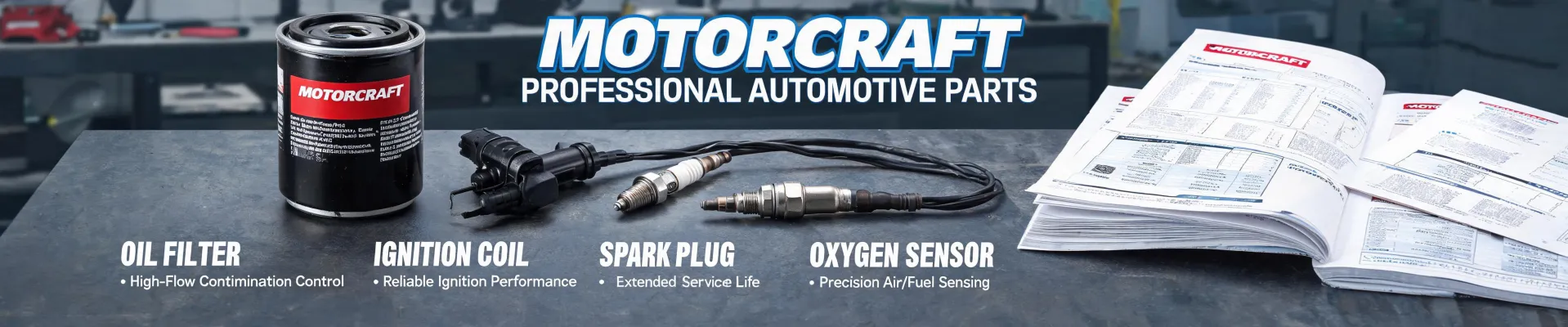
Why the cheapest replacement parts are the most expensive choice. A total cost of ownership breakdown covering Motorcraft fuel filters for the 6.7 Powerstroke, ignition starter switches, brake pad replacements, CARB-compliant catalytic converters, and ball joint vs. tie rod diagnosis.
Let me set a scene. You need a fuel filter for your Ford truck with the 6.7 Powerstroke. You search "motorcraft fuel filter for 6.7 powerstroke," see the $64 Motorcraft unit, then scroll down and spot a "compatible" option for $19. Identical shape. Positive reviews. Feels like an easy $45 win.
I've coordinated emergency parts orders for repair shops and small fleet operators for about six years. Roughly 200 rush orders—the "vehicle's down, find the part, don't matter the cost" kind. And after all of them, I can tell you that the $19 filter is the most expensive filter you can buy. Not because of what you pay. Because of what happens afterward.
The Surface Problem: We Compare the Wrong Numbers
Parts shopping looks like grocery shopping. Same dimensions, same fitment notes, looks interchangeable. So you compare prices. That's not a character flaw. It's how online retail trains everyone to think.
But "fits your vehicle" means the threads match. It doesn't mean the internal engineering matches. That distinction seems meaningless when you're scrolling a listing. It stops being meaningless the day a truck is dead at a loading dock.
I've been on the receiving end of that phone call too many times to treat it as a rare event. It's a pattern.
What's Actually Going On Here
Three scenarios show up constantly in my line of work. Each one is a different version of the same trap: the listed price isn't the final price.
1. The Fuel Filter That Didn't Actually Filter
The 6.7 Powerstroke fuel filter has two jobs. Catch particles, and separate water from diesel. The water-separation piece is the one people forget about. Water in a common-rail fuel system isn't a small problem. It's catastrophic. It ruins injectors, damages the high-pressure pump, and creates repair bills in the thousands.
The Motorcraft filter is engineered with a specific water-separation media and a micron rating the fuel system was designed around. The $19 version might have the same thread pitch and look the same in the box, but the internal media—the stuff that actually does the work—is where the corners get cut. It lets more water through. It saturates faster. The water doesn't fail the filter. The filter fails the fuel system.
I watched that exact chain of events destroy a client's truck in March 2024.
2. The "Compliant" Converter That Wasn't
CARB-compliant catalytic converters are another classic gap. CARB—California Air Resources Board—sets emission standards that are stricter than federal requirements. California, New York, and Massachusetts follow CARB rules. If you bolt on a non-CARB converter in a CARB state, you're not just asking for an emissions failure. You're breaking the law.
The price difference is substantial. A non-CARB converter might be $250. A genuine CARB-compliant catalytic converter runs $450–$700, based on publicly listed prices as of January 2025. So the temptation is real.
But I've watched people take that temptation. They save $200, spend $350 on installation, then fail the emissions test. Now they're buying the correct converter, paying labor again, and potentially paying a fine. The $200 saving turned into a $600 loss. To be fair, it's easy to make that mistake if nobody explains why the price gap exists.
3. The Diagnosis Gap: Ball Joint vs. Tie Rod
Now, ball joint vs tie rod. This one isn't about brands. It's about understanding what's actually failing.
Ball joints and tie rods are separate steering components, but the symptoms of wear are nearly identical: clunking over bumps, uneven tire wear, a vague feeling at highway speed. Without experience, you don't know which part is causing it.
I've seen a DIY-er replace both—double parts, double labor—because they couldn't tell which was bad. The noise continued, because the real issue was a sway bar link that cost $18. Diagnosis matters more than part brand. The right part installed once is cheaper than the wrong part installed twice.
The Real Price of the "Cheap" Choice
Here's where my emergency orders come in. I'm the person who gets the call after the cheap part has already done its damage.
In March 2024, a logistics client called at 2:30 PM on a Wednesday. Their Ford box truck with the 6.7 Powerstroke was dead at a loading dock in Illinois. The shop's diagnosis: water in the fuel system, injectors scored. We traced the maintenance history and found a no-name fuel filter from a previous service interval—a "compatible" replacement, the shop's buyer called it.
That truck was down for 26 hours. The client had to rent a replacement vehicle, bring in a second crew, and explain to their customer why the delivery window was missed. When we added everything up—rental, labor, parts, lost delivery fees—the total came to roughly $3,600. For a truck that should have had a $90 filter change.
I had no idea a $19 filter could do this.
That quote stuck with me because it's not really about the filter. It's about the invisible chain of costs that starts with the cheapest possible choice.
I had a similar situation with a Motorcraft ignition starter switch. The owner of a 2015 F-150 wanted to spend as little as possible on the repair. The initial quote used a Motorcraft switch at $62. The customer pushed back. I went back and forth between the Motorcraft part and a $14 no-name alternative. The no-name technically fit and had decent reviews. On paper, it was the "smart" choice for a tight budget. I went with the customer's preference.
It worked for four months. Then the truck died again, in the rain, outside a grocery store. Tow fee, second diagnosis, second installation, plus the $62 Motorcraft switch they should have bought the first time. Total: over $400 in costs and two roadside breakdowns, for a part that should have cost $62 once.
That second call taught me something. I stopped recommending price-based alternatives for safety-critical components. It wasn't worth the risk to the customer's day—or to my relationship with them.
How to Think About Total Cost Instead
The fix is a framework, not a product pitch. It's called total cost of ownership, and it's the only honest way to compare parts.
- Unit price. The listing price. The least informative number in the whole comparison.
- Installation labor. You pay it once if the part works, and again if it doesn't.
- Downtime. If the vehicle earns money, every hour in the shop is lost income. Often this dwarfs the part price.
- Secondary damage. A failing filter damages the injection system. Worn pads damage rotors. Bad steering parts wear tires unevenly.
- Compliance risk. CARB standards exist for a reason. "Fits" doesn't mean "meets regulations."
Brake pad replacements are a perfect example. A $30 set of pads might last 15,000 miles before the friction material is marginal. A Motorcraft pad set runs $80–$110 and is designed to work with the vehicle's braking system, including rotor metallurgy and caliper pressures. The labor to install either is identical. The second brake job you didn't have to pay for makes up the price difference many times over.
Motorcraft parts aren't "premium" in the sense of luxury upgrades. They're the parts that Ford engineered the vehicle around. That's it. And that's exactly why they tend to produce the lowest total cost over the life of the part.
Look, not every budget part is garbage. There are some decent aftermarket manufacturers. But here's the thing: when you buy a cheap replacement, you're betting that it matches the original spec without independent verification. The stakes of losing that bet are much higher than the money you save.
In my experience with 200-odd emergencies, the people who called me never remembered the money they saved. They remembered the breakdown, the missed deadline, the repair bill. And at some point, most of them ended up buying the Motorcraft part anyway.
The cheapest auto part is the one that doesn't fail. That's the whole argument.
About the author

Elise Novak is an automotive braking systems analyst specializing in brake pads, discs, rotors, calipers, shoes, drums, hoses, and complete brake kits. She uses UN Regulation 90 requirements and ISO 26867 dynamometer methods to examine friction stability, fade and recovery, wear, disc thickness variation, runout, and hydraulic integrity. Her work helps distributors, quality teams, and fleet buyers compare replacement parts, verify application suitability, and define incoming-inspection criteria.